In 2023, Enzo Angles walked away from one of the strongest table tennis systems in the world to join a league that had never played a single point.
He had spent more than ten years in Pro A, the top tier of French table tennis and one of the best leagues on the continent, if not the world. He knew the circuit, the ranking points, the comfort of a settled professional life. Then a project on the other side of the ocean asked him to leave all of it behind for something that, in his own words, was "literally nothing" yet. Most players in his position would have politely said no. Enzo, though, signed a contract in 24 hours.
To understand why, you have to understand how he looks at a table.
Yes to Something That Didn't Exist
The league was Major League Table Tennis (MLTT), the first professional table tennis league in the United States, founded by software entrepreneur Flint Lane. When it first reached out, Enzo did his homework.
"At first, I looked online for who Flint Lane was, and if I could trust him, because not everyone has the courage to start such a big project," he said. "One 20-minute call, a very nice match, a straightforward person. Twenty-four hours later, I had a contract. I could feel his passion, his ambition, and, more importantly, his trustability."
— Enzo
Here's the thing though. The interesting part is not that he said yes. It's why.
"Europe has incredible leagues. I grew up in that system, and it gave me everything as a player. To play another one wouldn't change anything," he explained. "I wasn't only looking at where the league was, because there was nothing. I was looking at where it could be."
— Enzo
That's the whole mindset. He didn't care where the league was. He only cared where it could go.
"Sometimes the biggest opportunities are the ones that don't come with guarantees," he added. "I wanted to be part of the first chapter instead of arriving ten years later, when everything was already established."
— Enzo
The First Name Called
When MLTT held its inaugural draft, the Carolina Gold Rush had the first overall pick in the history of the league. They used it on Enzo Angles.
"It was an incredible honor, because it meant people believed in me before I had played a single point in the league," he said. "Being the first overall pick means expectations are high. You want to perform, but you also want to represent the league well."
— Enzo
Carrying both, in that first season he was named the league's very first Most Valuable Player, and he has since led the Gold Rush to a championship. But it is a smaller detail that clearly means the most to him.
"Nobody can ever be the first draft pick again."
— Enzo
He is right. Records get broken, MVPs get won every year, titles get lifted and forgotten. But there will only ever be one first name called in the history of American professional table tennis, and it was his.
Leaving Comfort, Not Tournaments
I wanted to know what the hardest part of the whole thing actually was. His answer surprised me, because it had nothing to do with the sport.
"The hardest part wasn't leaving tournaments. It was leaving comfort," he said. "In Europe, I knew everybody. I knew every club, every venue, every routine. Moving to the US meant starting almost from zero."
— Enzo
There is a calm honesty in how he frames the risk, too. He does not pretend he was some fearless gambler betting his life savings.
"Worst case, if it didn't work, I would just go back. In the end, MLTT and Flint are taking the risk, not me. I'm just a player."
— Enzo
That humility is real, but I think it undersells what he did. Plenty of players guard their comfort like it's a trophy. Enzo left his behind to help build something that did not exist, and did it without demanding certainty first.
"Looking back now, I don't regret it for a second. Professionally and personally."
Writing the First Pages
Enzo has now lived both versions of a table tennis career: the established one and the brand-new one. His favorite part is the contrast.
"In France, you're joining a story that's already been written for decades. In the US, you feel like you're writing the first pages," he said. "When kids come to watch matches, when new fans discover table tennis because of MLTT, you realize you're helping create memories that didn't exist before. You're not only competing. You feel like you're contributing to the future of the sport."
— Enzo
And the American crowd, it turns out, meets the sport in a way he had never quite experienced.
"American fans love entertainment. Many people come without knowing every technical detail, but they immediately connect with the speed, the athleticism, and the intensity," he said. "They're incredibly expressive. They celebrate big rallies, momentum shifts, and dramatic moments in a way that's contagious."
— Enzo
For a publication that exists because table tennis is under-watched almost everywhere, this is the good kind of problem. Fans who show up for the spectacle and stay for the sport.
"That's one of MLTT's strengths," Enzo said. "It makes table tennis accessible without taking away from the quality of the competition."
— Enzo

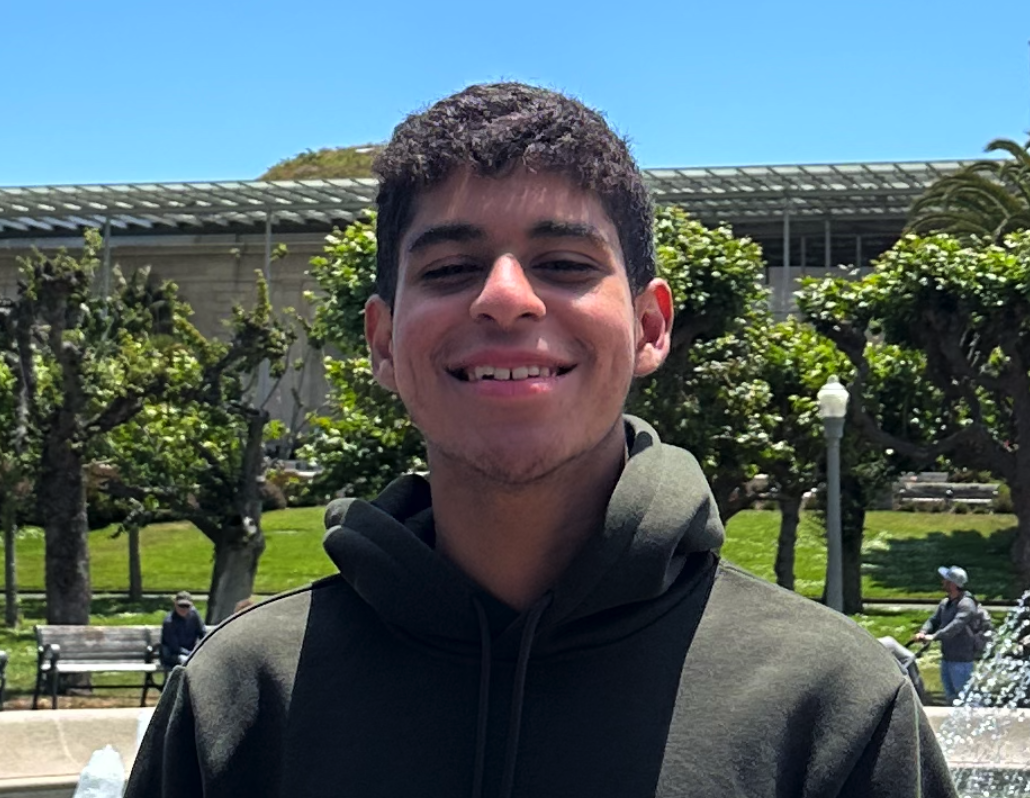
Enzo Angles, MLTT's first-ever draft pick and first Most Valuable Player.
The Golden Game
MLTT does not play like the world tour. Its team format runs through singles and doubles, and when it is level, everything collapses into the Golden Game, a single sudden-death race where players alternate every four points in a sprint to 21. As a competitor, Enzo had to rewire how he thinks about a match.
"It forces you to stay mentally engaged from the very first point, because every individual game contributes to the final team result," he explained. "And then there's the Golden Game, where all the pressure comes down to one short race. It teaches you to embrace pressure instead of fearing it. You can't hide. You have to make decisions, trust your instincts, and commit completely."
— Enzo
Then, with the honesty that runs through this whole conversation: "It's not for everyone. But personally, I really love it."
What the Game Still Lacks Here
I asked Enzo the question Sand Smash was made to spotlight. If he could hand American table tennis one thing it is still missing, something that would let the next talented kid arrive without crossing an ocean the way he did, what would it be?
"A complete development pathway," he said. "Kids need to see a clear future: local clubs, strong junior programs, college opportunities, professional teams, sponsors, and a career after playing."
— Enzo
The talent, he insists, is already there. What is missing is the road that lets it survive. In other words, grassroots development for the youth.
"Talent already exists, but for now, most of them stop training around 16 years old," he said. "The challenge is creating an ecosystem where that talent can grow without needing to leave the country at a young age."
— Enzo
I have written before about infrastructure, about cities with millions lacking clubs, academies, and places to train, about kids who never see the sport at all. Hearing the first MVP of an American league describe the exact same gap, just in a wealthier country, tells you how universal this problem is.
Before the Titles
Every player I profile eventually points back to the same place, and Enzo is no exception. Before the gold medal, before the draft, before America, there was a family.
"My family, especially my father and my grandfather. It would have been too difficult for my mom to let me go if I didn't have my grandfather and my father," he said. "Professional sport isn't an individual journey. Behind every athlete, there are people making sacrifices you don't always see."
— Enzo
He is generous, too, about the system that shaped him.
"I was fortunate to train in excellent French facilities and national training centers, with coaches who pushed me every day. The French system gave me discipline, structure, and high standards."
— Enzo
But he is not blind to its flaws, and here he says something I think every federation should read twice. He won European Junior gold at eighteen, beating Tomislav Pucar, a result that looks like a fairy tale from the outside. From the inside, it came at a cost.
"At the time, France was shaping players to perform as juniors. It's a big mistake," he said. "When you're 18, your career is just starting. And me, I was already tired."
— Enzo
He notes the system has since changed. But the warning stands: a medal cabinet full of junior trophies means nothing if the player is burned out before the real career begins.
Nine Match Points
If you want the one moment that explains how Enzo thinks, read this closely. It is a game he almost lost.
In the deciding game of the 2021 Finlandia Open final, against Portugal's João Geraldo, Enzo faced nine match points. Nine separate times, his opponent stood one point away from ending it. One nervous miss, and it would be over.
Surprisingly, he saved all nine match points and won the title.
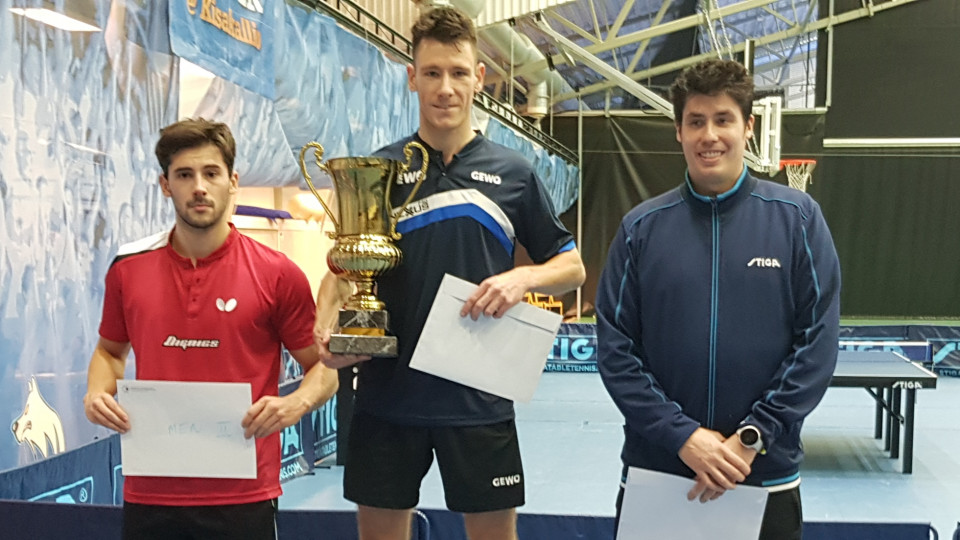
Enzo Angles (center) on the podium after saving nine match points to win the 2021 Finlandia Open.
"Ironically, I wasn't thinking about winning anymore," he told me. "I was only thinking about the next point. When you're facing that many match points, you stop worrying about the outcome, because you have no choice. You simply fight for one more rally."
— Enzo
That match handed him a sentence he still leans on today:
"As long as the match isn't over, your opponent hasn't won. Momentum can change incredibly fast if you stay emotionally present and keep believing."
— Enzo
Read that back, and the rest of his career makes sense. A player who refuses to accept a lost match is exactly the kind of player who looks at an empty, unproven league and sees where it could be instead of where it is.
For the Player With One Club and No League
Sand Smash readers sit in more than 135 countries, and many of them are reading this from places with one club, no league, and no clear way up. I told Enzo that, and asked what he would want those players to take from his story.
"Don't let your environment define your ambition," he said. "Of course, great facilities help. But passion, curiosity, discipline, and consistency are available everywhere. Today you can learn from videos, connect with coaches online, study professional matches, and build knowledge that wasn't accessible twenty years ago."
— Enzo
As a player myself, training in a region where the sport is treated as minor, that landed hard. Not because it is comforting, but because it is true. The kid with one table and a phone full of match footage has more than Enzo's generation ever did. The only thing that cannot be downloaded is the refusal to quit.
The Bet Nobody Guaranteed
Everyone told Enzo that a league which did not exist was a risk. He looked at where it could be instead of where it was, and he fought for one more rally. He believes the payoff reaches far beyond himself.
"If MLTT works, it could change the way people see professional table tennis," he said. "It has shown that high-level table tennis can also be presented as an exciting spectator sport. Success in the US doesn't only benefit American table tennis. It raises the visibility of the entire sport, and that's something every player should be excited about."
— Enzo
That is the part that matters for all of us, in every country, watching from the outside. When a settled European star crosses an ocean to write the first pages of something new, and the halls fill, and the kids show up, the whole sport gets a little more visible.
Enzo Angles bet on a game nobody had played, in a league that did not exist, in a country where the sport is not famous. He was the first name called, and he is still doing what he did in that final in 2021, refusing to believe the match is over, fighting for one more rally, one more fan, one more page.
"We're playing. We're winning. Now we want to be seen."
— The Dispatch —
Every story, first.
Get the latest table tennis stories, player profiles, and advocacy updates delivered to your inbox.
We respect your privacy. Unsubscribe at any time.