There is a woman in Shanghai who carries a racket in her bag everywhere she goes.
She is 64. In 2022, a hospital in the city told her she had Parkinson's. Since then she has tried everything they offered her. Traditional Chinese medicine. Western medicine. Physical rehabilitation. All of it helped, she says. Then she started playing table tennis three times a week, one hour each time, summer and winter, and that is when the progress began.
The shaking in her hand has decreased. Her range of motion is better. She is less nervous. She lives on her own, travels, does her own housework. Since 2024 she has competed at city, provincial, and international level. Three gold medals, two silver, one bronze.
"What is more gratifying than being healthy?"
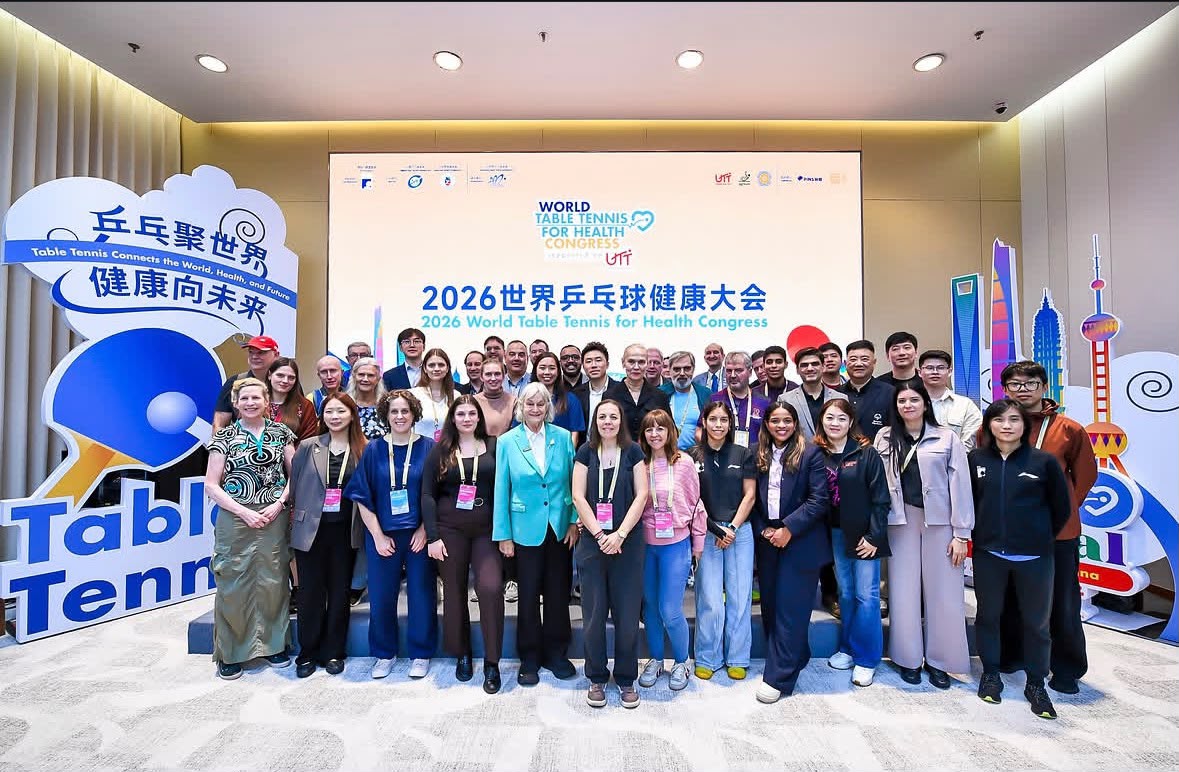
She said that into a microphone in Mandarin, in a lecture hall at Shanghai Jiao Tong University, in front of a room of neurologists, economists, and federation officials who had flown in from four continents to figure out whether she is right.
Then she said the line that followed me around for two days.
"I feel like eighteen."
She looked it. Not the face, exactly, but the way she stood. If you had put her at a table in my club in Al Khobar, you would not have guessed anything was wrong until someone told you.
Here is the part that does not make sense the first time you hear it. Almost nobody in that room has enough proof to prove why.
Three Hundred and Forty
If you have read Sand Smash before, you have met this event without knowing its name. In June I wrote about Stefan Sigfridsson and Christine Knapp, two players with Parkinson's picked at a raffle in Helsingborg, Sweden, and sent to the World Masters in Korea. The thing that picked them was the World Table Tennis for Health Festival.
The Festival is the ITTF Foundation's flagship health event. It runs the World Parkinson's Table Tennis Championships and the World Alzheimer's Table Tennis Championships side by side, and in the middle of the week it holds the World Table Tennis for Health Congress, where the scientists and the players explain to each other what they know.
The 2026 edition ran from October 20 to 25 in Shanghai. It was the fourth Festival and the first outside Europe, in the year the International Table Tennis Federation turned one hundred. More than two hundred players with Parkinson's and Alzheimer's came from 22 countries. Counting coaches, families, and Congress guests, more than 340 people from 35 countries registered. The biggest edition yet.
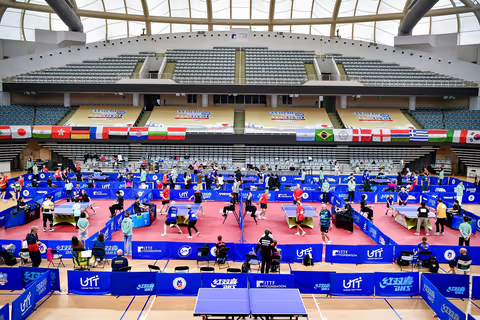
The woman from Shanghai was one of the players. The rest of us were there to figure out what she already knows.
What She Cannot Prove
The Congress ran on October 23 and 24. Fourteen presentations, and one question underneath all of them. The woman from Shanghai knows table tennis works. Why can't we say so?
Dr Barbara Ainsworth of Shanghai University of Sport gave the opening keynote, and she did not start with table tennis. She started with Ralph Paffenbarger, who spent decades proving that physical activity changes how long you live. The early findings were blunt. Get yourself out of the lowest fitness group and your risk of dying from any cause drops by nearly 35 percent. Just get out of the bottom.
Then she said something nobody had ever told me, a professional athlete. As you get older, you have to do more to keep the same low risk. The bar moves up.
In 1994, she said, researchers did not know how different types of activity affect different parts of our lives. For table tennis, in 2026, we still mostly do not. There are studies on balance. There are a few. Not enough to stand in front of a health minister and say it out loud.
Associate Professor Huang Wenwen of the China Table Tennis Academy gave the second day's keynote, and she gave the sport a dose. Table tennis, she said, is cognitive, aerobic, and social at once. Three in one. At least 150 minutes a week at moderate to high intensity. Two or three sessions to start, four or five once the body adapts. A prescription, with a number, not a doctor telling you to exercise and leaving the room.
She also said a sentence I underlined and still do not know what to do with. Since China's national team was founded in 1952, she said, not one of its players has been diagnosed with Parkinson's before the age of 80. One team, one country, not a controlled study. But it sits right in the gap between what we see and what we can prove.
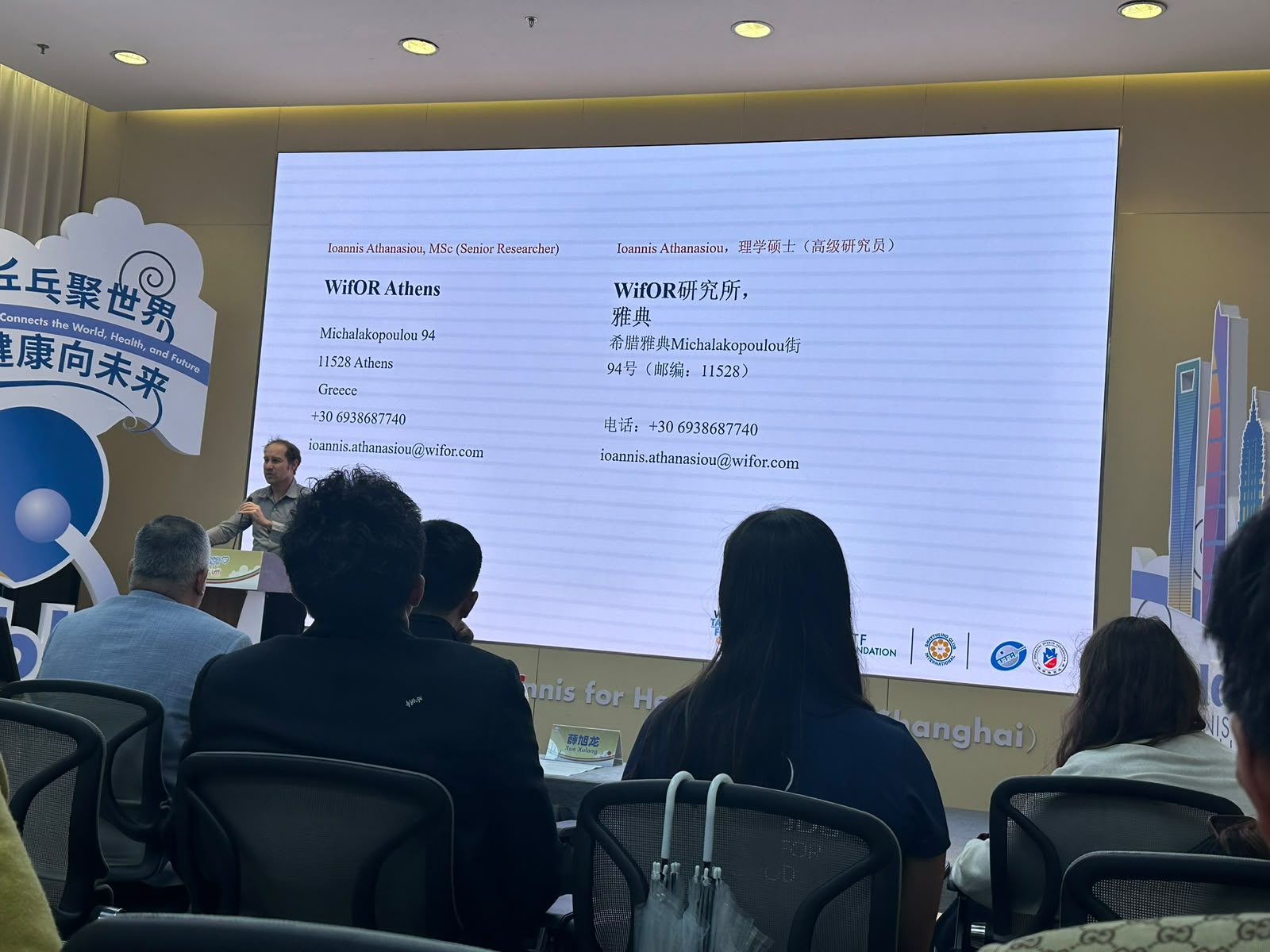
Ioannis Athanasiou of the WifOR Institute was the one trying to turn that gap into money. Healthier people work more and cost the state less. Pushing people into table tennis should raise GDP. Every finance minister wants that.
"If sport is so good, why don't we rush to invest in it? We know a lot of things are good, and we don't do them. Life does not work this way."
— Ioannis Athanasiou
The health value of a table tennis hall spills over onto people who never paid for it. Fewer falls. Fewer prescriptions. Fewer lonely people. Economics is bad at measuring that spill, so governments do not fund it until the proof is overwhelming. That is why the sport is underfunded at the grassroots in countries like mine, and it is why the research matters. Nobody writes a cheque for a feeling. They write one for a number.
Balance. Minutes per week. GDP. That is what the scientists can measure. When the players took the microphone, they talked about something else.
Use Your Head
Liz Franz of the University of Otago said the thing that we as table tennis players all know.
"Table tennis is strengthening our sense of self, not only the physical and the cognitive."
— Liz Franz
There is no study for that yet. There is Nikolas.
Nikolas is 44, from Sweden. He was diagnosed with Parkinson's two and a half years ago. His doctor recommended boxing and dancing. Nikolas is a thin man. He does not look like a dancer, and he said so. He told his doctor he was going to play table tennis instead.
He knew the sport. He even works for Stiga, a huge table tennis brand. After the diagnosis, he could not play the way he used to. The serve was gone. The spin was gone. Three years later, he is almost back to his old level.
"You must use your head. That's the benefit."
— Nikolas Kjellström
He told one story to explain it. There was a rumor that his opponent had a wicked short underspin serve. Nikolas set up for it. The ball came long instead. And in that half second, everything in him had to move. Hands, feet, eyes, decision. A body with Parkinson's asked to solve a problem it did not expect, and solving it. That, he says, is where the benefit is.
That is the rally. For Nikolas, that is the treatment, one serve at a time.
An American player with Parkinson's put it even shorter, from the floor, when someone asked what he would tell the newly diagnosed.
"Doing something is better than doing nothing."
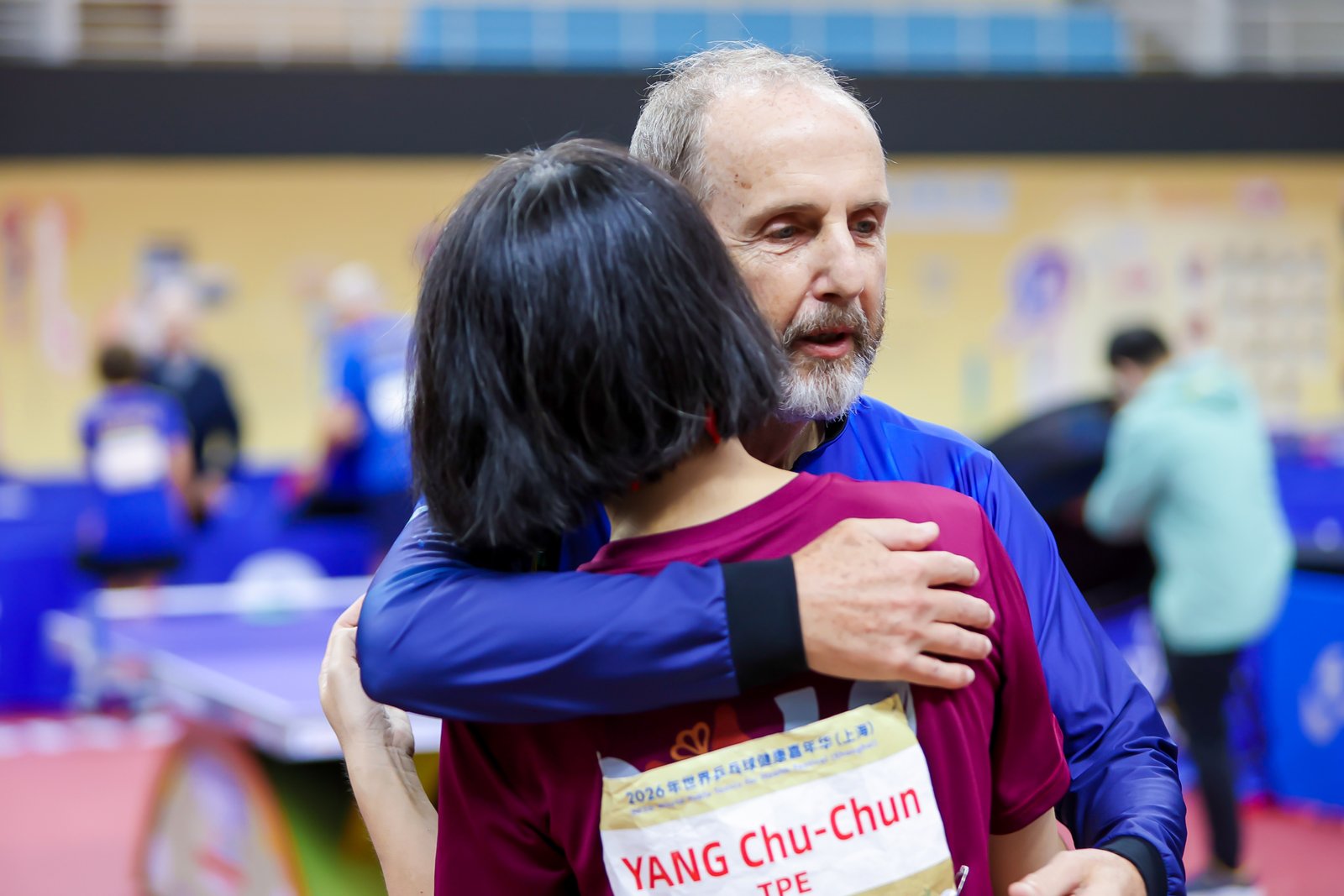
On the last day, the Foundation named Nikolas and Nuria Santos of Spain as its two ambassadors for 2027. They will represent it at the World Masters Championships in Las Vegas next year, the same road Stefan and Christine walked to Gangneung.
Nikolas did not wait for a study before he picked up a racket. Some of the people on the stage did not wait either.
An Email
Bettine Vriesekoop played three Olympic Games for the Netherlands. Today she runs a foundation that helps people with Parkinson's move. It did not start with a strategy, and it did not start with a study.
A man wrote to her. He had Parkinson's. He wanted to know if she would have breakfast with him once a week. She said yes. Everything her foundation does now grew out of that one breakfast.
I recognized it immediately, because that is how Sand Smash works. I email a federation. Most of the time nothing happens. Sometimes someone replies, and a story in Angola or Peru exists because of it. Small things push action, if the person on the other end answers.
Bettine said one number three times, and the third time she said it slowly so we would write it down. The Netherlands has 470 table tennis clubs.
Four hundred and seventy doors, and a man with Parkinson's still had to write an email to find one that opened for him.
That gap, between the clubs that exist and the people who never find their way into one, is what a team from the Hungarian Society of Lifestyle Medicine set out to close. They built a model that connects doctors to sports clubs, so that when a doctor tells you to exercise, there is somewhere to go. The question they opened with was one of the best lines of the two days.
"If hospitals are built for the sick, and sports clubs are built for the fit, who takes care of the millions in between?"
I have been one of the professionals since I was twelve. My parents have never been either. They are the millions in between, and so is almost everyone I know at home.
Not Yet
A conference is easy to forget, and the Foundation seems to know it. The work in China started a month before the first serve. In September it trained 64 coaches from across the country to run sessions for people with Parkinson's and Alzheimer's, so there is now someone in their own cities who knows how. On the opening day of the Festival, the tables were donated to eight organisations, hospitals, sports bodies, community fitness centres, and Beijing PINS Medical among them, so the people who played this week have somewhere to play next month. Doctors and coaches who had never been in the same room left with each other's numbers. The flag was passed to Goa, India, for the next edition. The point of a Festival like this is not the week. It is what the week leaves behind.
And after an hour of sitting on the first afternoon, someone guided us to dance the Macarena, and a room of professors and neurologists stood up and danced it. It was my first conference. I did not know they could be like that.
Every evening I walked out of that hall with the same question the presentation from Hungary asked, and I carried it back to the hotel. Who takes care of the millions in between? Most of the people I love do not play a sport. They never had a club nearby, a coach who answered an email, or a doctor who told them where to go. Everything I heard in Shanghai assumes those things exist. In a lot of the world, they do not yet, and the research will arrive long before the infrastructure does.
The person waiting at the hotel was my father. Every evening I told him what had happened during the day, and we discussed it.
My uncle was diagnosed with Parkinson's two years ago. My grandfather had it. My father spent thirty years in the medical industry and did not know table tennis could do anything for the disease until I told him, after I met Stefan and Christine. In Shanghai, he got two days of me telling him about scientists saying the same thing.
On the second night he asked me if we have a program like this at home.
We do not. Not yet.
Nobody is taking care of the millions in between. Not yet.
The proof is not finished. Not yet. The funding is not there. Not yet. Most of the world does not have 470 clubs. Not yet.
But for two days in Shanghai, the researchers, the doctors, the federations, and the players were in the same room, talking to each other. This is a step forward. A 64-year-old woman feels eighteen, and she is not waiting for the research paper to be published. Doing something is better than doing nothing. Everyone in that room is doing something. Sand Smash is going to keep writing it down.
The ITTF Foundation runs this work year round, through its Table Tennis for Health programme and the World Table Tennis for Health Festival. If this story moved you, visit the ITTF Foundation and follow it on social media to see what happens next, in Goa and everywhere else.
If you are a federation, a foundation, a researcher, or a program with a story the world is missing, reach out. Sand Smash is listening.