The First Set
It was close. He was a few points from taking it.
The match was a WTT final. The opponent was Saudi Arabia's Yousef Hanifa. The prize was Rakan's first WTT title.
He lost the match.
"I was close. He took the first set. I just needed a bit more experience."
— Rakan
He doesn't say he was missing technique. He doesn't say he was missing power. He says he was missing حنكة — the Arabic word for savvy, ring-craft, the in-match wisdom that only comes from playing experienced opponents many times over.
He is the U15 champion of Jordan. He won the national title 3-0 in the final and did not drop a single set across the entire tournament. In 2025 alone, he medaled at four WTT events — Sulaymaniyah, the UAE, Jordan International, and Libya. He took bronze at the Arab Championship and silver at West Asia.
The medals tell you he is good. But that set against Hanifa tells you what he is still missing.
Before School
Rakan wakes up at 7. His mother wakes him. He eats breakfast with his family. His father drives him to school.
In Jordan, table tennis is not football. It is not basketball. Most of Rakan's friends did not know it was a serious sport until they watched him win.
"At first they said table tennis is an easy sport. When they tried it, they realized how hard it is."
— Rakan
When tournaments take him abroad, the school sets up private make-up sessions so he doesn't fall behind. They are accommodating in a way most schools wouldn't be. The country's U15 champion still has to make up the lessons he missed flying to Doha.
The Drive
After school, Rakan goes home, eats a light snack, and sometimes naps. Then his father drives him to the Orthodox Club. Forty-five minutes each way.
His father drives him in the morning. His father drives him in the afternoon. His father drives him home at night.
His father also pays for the tournaments.
The Cost
In 2025 alone, Rakan's international competition cost approximately $13,000. Flights, hotels, registration fees, every line item. The federation's budget reaches the Arab Championship and West Asia. The federation is working with the resources it has. Everything beyond — the WTT events, the camps abroad — is paid for by his family.
"If my father couldn't pay, my ranking would go. My level would drop. There isn't an Arab or West Asia championship every year."
— Rakan
He is matter-of-fact about it. He has known for some time that his international career runs on his father's salary.
National teams from larger federations arrive at WTT events with full coaching staff, physiotherapists, and sometimes psychologists. Rakan and his father arrive together. The Japanese, Chinese, and German players Rakan meets in the brackets are not surprised that they are at a WTT event. They are surprised to find a Jordanian player in the same draw.
"They get surprised. The foreign players, especially. They didn't expect Jordan to be there."
— Rakan
That surprise is the gap the medals don't show.
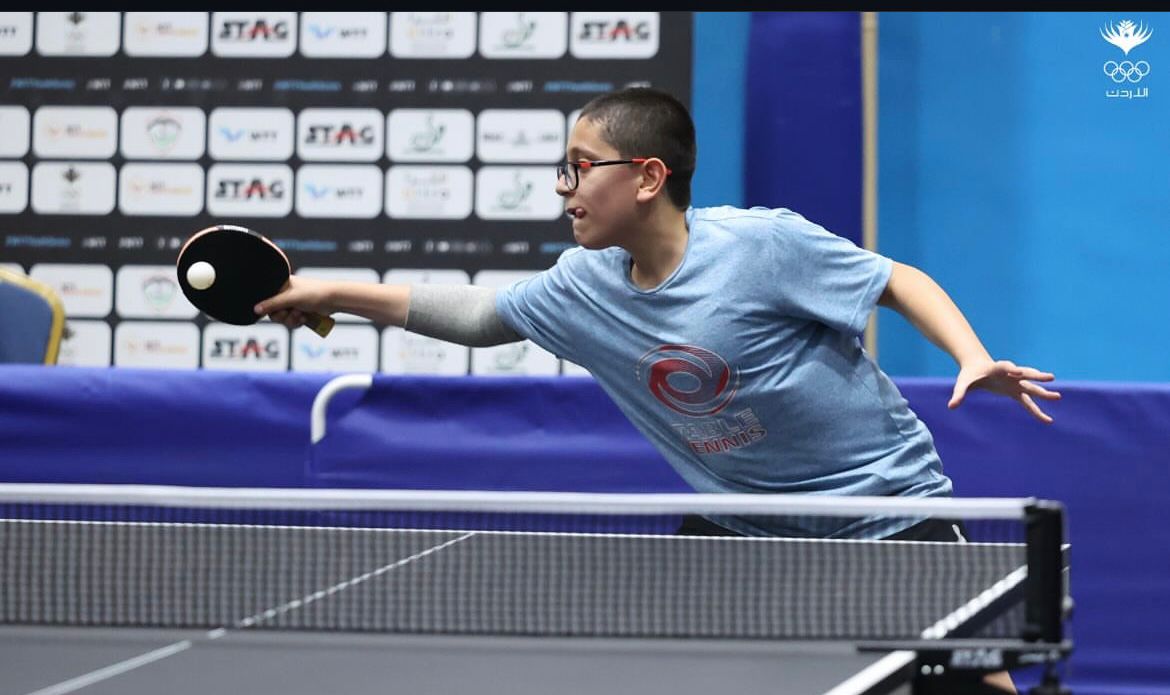
Rakan during a WTT event. The reach and the glasses are unmistakable.
The Training
Rakan arrives at the club around 4. The first thing he hears is the sound of the ball against the table. The first thing he does is greet his coach.
The warmup begins with a fifteen-minute light jog. Then specific muscle work — the elbow, the shoulders, the legs. Then the players are divided according to the day's plan: serve drills, multi-ball work, and technical sessions.
Rakan's main training partners are Issa Al-Shamma and Zaid Abu Yaman. Zaid is older than Rakan, and Rakan calls him "one of the best Arab players."
For the past two years, the team has not had access to a foreign coach.
"It has been two years. We are waiting for a coach from abroad."
— Rakan
International coaching exposure is one of the single biggest accelerators for a junior player. The styles, the systems, the way the sport is played at the top level — all of it comes through coaches who have lived inside that world. For a player still under 15, two years is a long time to develop without that layer.
His father pays for him to attend training camps abroad. When Rakan is in those camps, training every day against players with more matches behind them, he sharpens. His game opens up. He returns to Jordan stronger than he left.
Then, in Jordan, the level drops.
"When I finish a camp and come back to Jordan, my level drops a little. It's not the same."
— Rakan
He is the U15 champion of Jordan anyway.
There are moments in training when Rakan feels he can't continue.
"I push through. I keep going. I remind myself of my dream."
— Rakan
The training lasts four hours. It ends at 7.
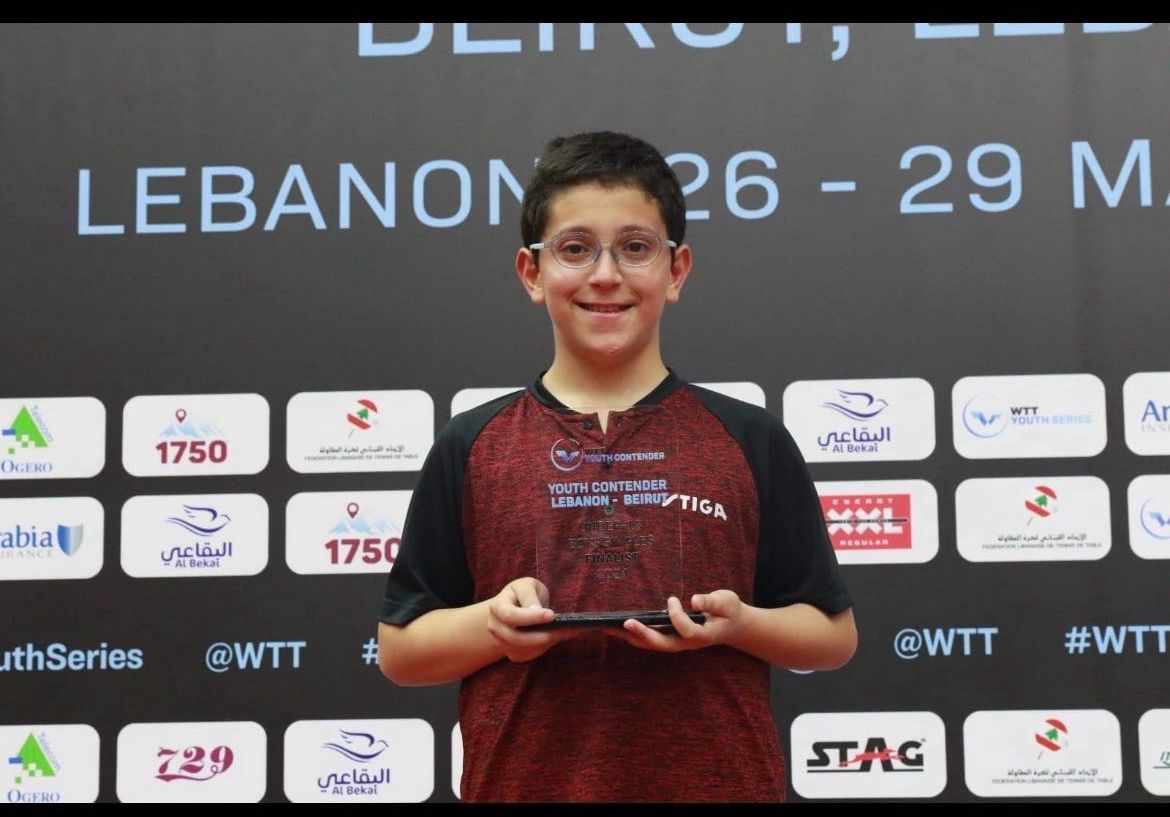
Rakan at the WTT Youth Contender Lebanon — Beirut 2024. Under-15 Boys Singles finalist.
The Flag
When Rakan steps onto a court at a WTT event with the Jordanian flag on his back, the feeling is real.
"I feel pride. I feel belonging. I am proud in front of people that I am Jordanian."
— Rakan
The flag is the same flag he wore as a younger player when nobody knew his name. Now he is the country's U15 champion, with WTT medals on his shelf, and most of the people he passes on the street in Amman still have no idea the sport exists at his level.
The Six
If he were federation president for a year, he says, he would focus on six players. Send them abroad. Bring them coaches. Give them everything.
"If I had the power, I would focus on six players, send them abroad, bring them coaches and everything they need."
— Rakan
The answer comes from where he stands. He is one of the six. He sees his ceiling because he hits it every week. The resources he needs to climb past it are real.
The system has invested what it can at the top. The growth that comes next is the one underneath — the U13s and U11s coming up, the towns where there is no club, no coach, no table. A program does not survive on six players. It survives on what feeds the six, year after year.
Rakan is right about what he needs, but the harder work is the layer that doesn't have a medal yet.
The Fork
His father picks him up after training. They drive forty-five minutes home. Dinner is light. He does his homework. He sleeps at 10.
At some point, the choice will come. Rakan will leave Jordan to train somewhere the daily environment matches the level he is competing at internationally — or he will stay, train through the gap, and accept that his ceiling may be shaped by what is still being built around him. The sport in Jordan is still developing. Both roads carry a cost.
He was close in the first set against Hanifa. The set got away, but his dream definitely did not.
From the Orthodox Club to the WTT tour, Rakan is Jordan's U15 champion. The road ahead splits, and he is approaching the fork forty-five minutes at a time.
— The Dispatch —
Every story, first.
Get the latest table tennis stories, player profiles, and advocacy updates delivered to your inbox.
We respect your privacy. Unsubscribe at any time.