There is a man in Gangneung, Korea, who cannot walk more than five hundred meters without his toes curling under him.
The cramps arrive most days. They twist the toes on his right foot until he cannot straighten them, and every step turns slow, careful, and short.
His name is Stefan Sigfridsson. He is sixty-eight. He flew roughly twenty-four hours from a small village in Sweden to be here, by himself, to play table tennis.
Here is the part that does not make sense the first time you hear it. When Stefan plays, the cramps go quiet. Sometimes they disappear completely.
"When I play, I feel like I have nothing. No Parkinson's. Nothing. Then around one hour later, it comes back."
— Stefan Sigfridsson
Christine Knapp, fifty-nine, from Klagenfurt in Austria, says almost the exact same thing in almost the exact same words.
"During training, I think I am not sick. I am not old. After, I know again. But during, it is the best time for my body."
— Christine Knapp
Two people, two countries, the same disease. And the same handful of hours when the disease loosens its grip and gives them their bodies back.
Two Thousand Players, and Two Who Are Different
The ITTF World Masters Championships run in Gangneung from June 5 to 12. More than two thousand players from around the world have travelled here to compete. Stefan and Christine are two of them, and they are not playing in some quiet side bracket of their own. They are in the draw with everybody else. Christine's first match was against players from Germany, Australia, and India. Stefan opened against a man he describes, with a small laugh, as "very good."
That is the thing almost nobody talks about. A player with Parkinson's, competing at a world championship, in the same competition as players who do not have it. If you are over forty, you probably know what Parkinson's is. If you are younger, there is a decent chance you have never thought about it at all, and almost no chance you have pictured someone living with it standing at a table at a World Masters, serving, looping, fighting for a point.
I am sixteen, and I am exactly the kind of person I am describing. I did not know what Parkinson's was until two years ago, when my uncle was diagnosed. That is when my father told me it runs in our family, and that my grandfather had it too. Despite my father working in the medical industry for thirty years, he did not know that table tennis could transform the lives of people with Parkinson's until I told him when I found out about Stefan and Christine.
Both of them earned their place the same way. At the 2025 World Table Tennis for Health Festival in Helsingborg, Sweden, the ITTF Foundation ran its Parkinson's and Alzheimer's championships alongside a health congress, with 189 players from 23 countries. At the closing ceremony, a raffle drew two names, one man and one woman, who would represent the Foundation at the World Masters in Korea. Stefan and Christine were the two names.
This is their story. At the end of it, there is a way for you to be part of what happens next.

Support Stefan & Christine's journey
ITTF Foundation — Table Tennis for Health
Moved by their story already? You don't have to wait until the end. Learn more about the campaign, or back Stefan and Christine's trip to Gangneung right now:
Christine: Klagenfurt to Korea
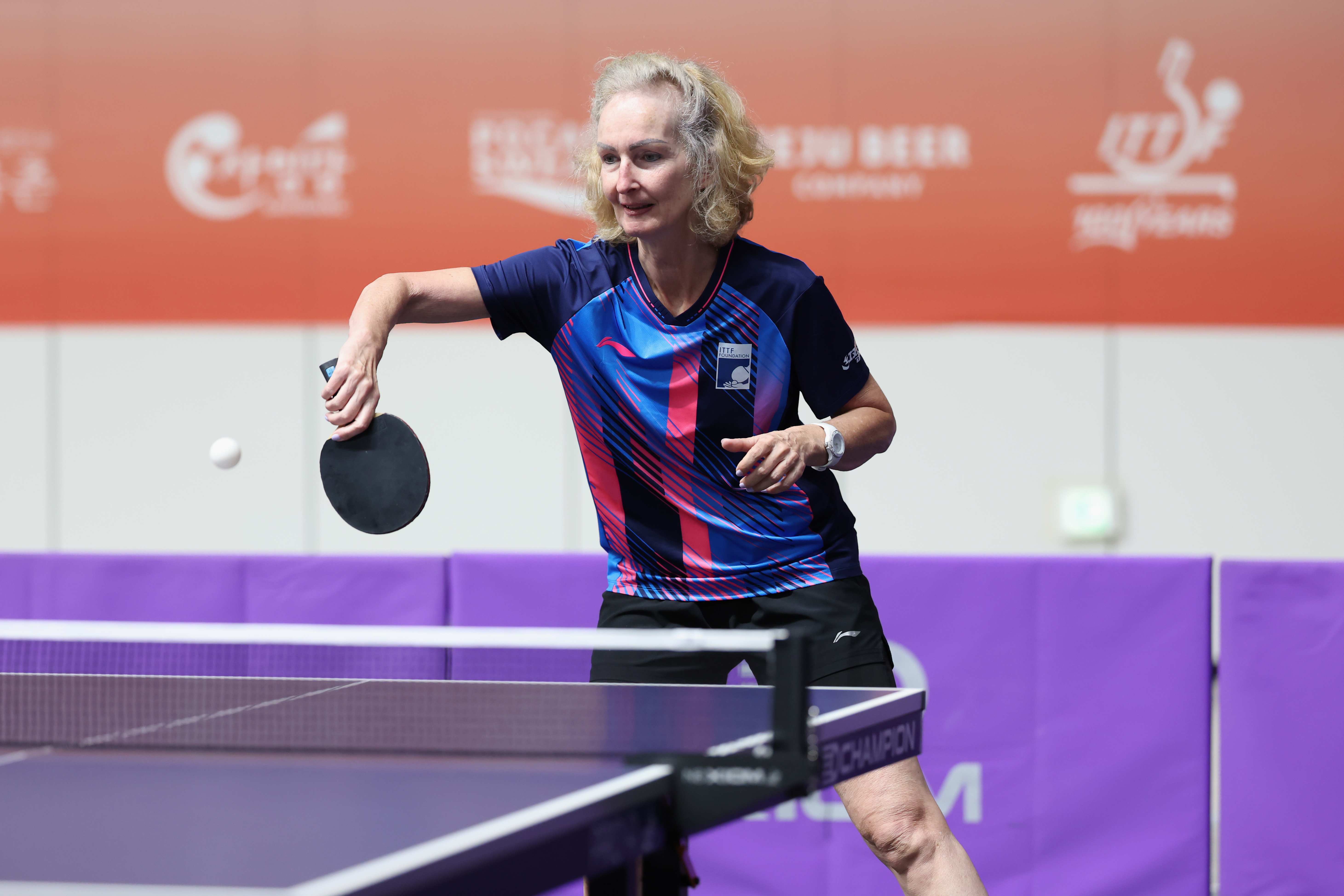
Christine Knapp in action at the ITTF World Masters, Gangneung.
Christine Knapp was living a full life when Parkinson's arrived. Self-employed in the fashion industry, a mother of three, a grandmother of one, fifty-nine years old. The diagnosis came in 2021.
She had played table tennis as a child, only for fun, and then set it down for decades, the way most people do. It came back to her by accident. In 2024 she went to a wellness hotel with a friend, picked up a bat, and felt something she had forgotten. When she got home, she went looking for a club, and for the first time in her life she learned that table tennis for people with Parkinson's even existed. She found TTC Gurnitz, which runs specialised Parkinson's training.
There she met her role model. Agnes Jan, a five-time Parkinson's world champion, trains at the same club, and she took Christine under her wing, helped her, fitted her with pimpled rubber, encouraged her.
"I am very excited to know her and to play with her."
— Christine Knapp
Now Christine trains twice a week, and stays active in the week with other sports. In a little over a year and a half of playing, she has competed in three Austrian tournaments and travelled to the World Championships in Helsingborg, where she won two medals.
When she talks about that, her voice changes.
"I was so excited to win a medal. It was my dream. I won two. My club was excited with me. I have been playing one and a half years."
— Christine Knapp
Competition is not easy for her, and she is honest about why. Parkinson's gets louder under stress and nerves, exactly the conditions a tournament creates. That makes every match a particular kind of test, the disease and the pressure pulling in the same direction.
And yet, like Stefan, she has found that the table quiets it.
"During training, I never think I am sick. I never think I am old. It gives me so many benefits."
— Christine Knapp
She made the journey from Vienna with her husband at her side, a direct flight of about eleven hours, then a four-hour bus from Seoul to Gangneung, arriving at the hotel exhausted. She had never flown so far in her life. Her first match was against that field of players from Germany, Australia, and India, and she walked off it nervous and happy at once.
"It was so good. It was very fun. I am a little nervous, but I am satisfied."
— Christine Knapp
She is dazzled by the scale of it.
"I am very impressed. Really good players. It is a great dynamic to meet people from so many countries."
— Christine Knapp
Stefan: The Long Way From Arbrå
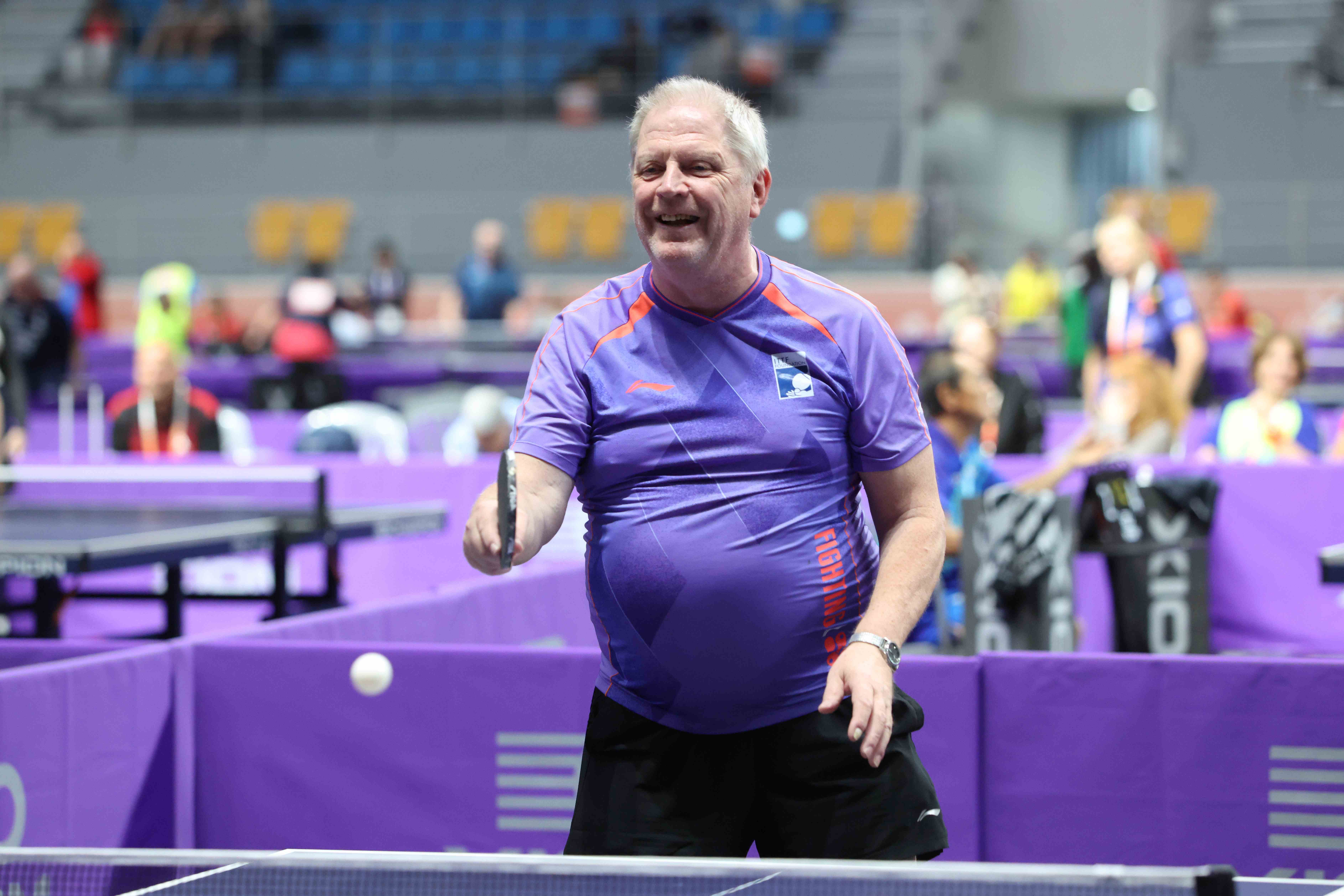
Stefan Sigfridsson at the ITTF World Masters, Gangneung — sixty-eight years old, twenty-four hours of travel, and a smile on his face.
Stefan grew up with a bat in his hand. He started at six or seven, playing his friends in a cellar, and the round-the-table games during school breaks that every Swedish kid of his generation remembers. He started competing properly at eighteen.
Then life pulled him somewhere bigger than a club. In 1984 he spent six months in Mozambique teaching literacy, and in 1985 another six in Guinea-Bissau. His classes were all adult women, because in those communities the girls were the ones taken out of school young to carry water, cook, sell at the market, and grow food.
"I think for these women it made a difference."
— Stefan Sigfridsson
It is the first clue to who Stefan is. He shows up for people. He has been doing it his whole life.
At thirty, living in Rotterdam, he started competing again, and he kept at it for twenty-five years, mostly in the fourth class. He was never chasing trophies.
"Playing the game is fun in itself, but the social interaction is just as important."
— Stefan Sigfridsson
When a shoulder injury left him unable to twist his arm enough to return hard and spinny balls, he did not quit. He switched to a pimpled rubber and kept playing. The trouble came quietly. Looking back now, Stefan can trace his first Parkinson's symptom to 1998, a cramp in his right forearm while he played. He did not know what it was. By 2015, the shaking had taken his game from him. He was losing to players two classes below him. He was falling. He could not control his own arm.
So he stopped.
"I couldn't take it, because I was so bad."
— Stefan Sigfridsson
He was diagnosed with Parkinson's in 2017. The years away were long. His left knee got so bad by 2022 that he could barely manage stairs, and it took an operation in September 2023 to fix it. Then, in April 2024, the table tennis club in Söderhamn, SUIF, started a training group for people with Parkinson's. Stefan went back. He drives fifty-three kilometers each way to train with them, and he does it gladly.
What he found there was not only the sport. It was the thing he had described to me, the reason he gets in the car for that drive every week.
"In the beginning I have cramps. But as I play more, it goes away. Afterwards I am mostly very good. I can even drive better on the way home. It's a nice feeling, driving home."
— Stefan Sigfridsson
The toes that will not straighten on an ordinary afternoon let go for a few hours after he plays. He gets, in his words, a déjà vu, a sense of being cured, before the symptoms drift back in. For a man whose body fights him most of the day, table tennis is a few hours of peace, bought one rally at a time.
Stefan knows this disease from more than one angle. His mother, ninety-two, has Parkinson's too, and struggles now with her speech. His father played table tennis, and used to play with Stefan and his older brother sometimes. And he remembers, as a boy, a friend's grandmother who shook all the time. The kids called her "funny Anna." No one ever explained it to them.
"Now I know I also have Parkinson's. But no one told us about it when we were young. It's good that younger people know more about it now."
— Stefan Sigfridsson
He made the trip to Korea alone. He flew out of Stockholm at six in the morning, layovered in Paris, waited four hours, layover in Shanghai, waited four more, and landed in Seoul the next afternoon. Around twenty-four hours, door to door, at sixty-eight, with Parkinson's. He came anyway, because it was a chance to play, and a chance to meet people.
One detail he mentioned has stayed with me. On the whole brutal journey, the cramps that haunt his feet never came.
"I had nothing during the trip."
— Stefan Sigfridsson
As if his body knew where he was going.
He lost his opening match, and it did not bother him.
"I found it fun, and he was very good. I didn't play well, but he won anyway. When I looked at the others, I felt like I had a chance."
— Stefan Sigfridsson
He had come to Gangneung wanting one thing, to win one game. By the time the singles, doubles, and mixed doubles were done, he had it. One game, in the mixed doubles with Christine as his partner.
"I come here to play."
— Stefan Sigfridsson
That is the whole of it.
What the Table Gives Back
Ask Christine what the Parkinson's community has meant to her and she does not hesitate.
"Parkinson's is like a family. We know each other. We help each other. We encourage each other. It is a very important community for me."
— Christine Knapp
I have written this sentence before on Sand Smash, about other people, in other countries. A sport the world barely watches, held together by people who love it and refuse to let it go. With Stefan and Christine, the stakes are simply higher. What they get from the table is not a ranking. It is mobility, balance, concentration, confidence, and a few hours each week when the disease forgets to show up.
And this is bigger than the two of them. The ITTF Foundation runs a whole programme on this exact idea, Table Tennis for Health, using the sport to help people living with Parkinson's, Alzheimer's, and other conditions, in places most of the table tennis world never looks. The Helsingborg festival that sent Stefan and Christine to Korea is part of it.
Both of them want the same thing from this article, and it has nothing to do with medals.
Christine's message to anyone newly diagnosed is the one she wishes someone had given her.
"Many people with Parkinson's are afraid to go out. They don't want anyone to know they are sick, so they stay home, and they get depressed. It is important to know that other people have the same disease. You can play. You can have a community. For your body and your mind, it is important. Keep moving. Stay active."
— Christine Knapp
Stefan's is quieter and harder won. He spent his boyhood not understanding why "funny Anna" shook, and his adulthood learning the answer in his own hands.
"We are not special. Some of us are shaking. But we can play, and we can get better. I am very proud to represent the ITTF Foundation, because it gives hope to other people with Parkinson's."
— Stefan Sigfridsson
Five Dollars
The ITTF Foundation built this. Through its Table Tennis for Health programme and the World Table Tennis for Health Festival, the Foundation has spent years proving that this sport can be a tool for health and inclusion, not just a game. Sending Stefan and Christine to Gangneung is the next chapter of that work, following an earlier edition at the 2024 World Masters in Rome.
But getting two people to Korea is not free, and this is where you come in.
Every dollar donated goes directly to the players. Airfare, accommodation, nutrition, and registration fees. Nothing else. Stefan made the twenty-four-hour journey alone, at sixty-eight, with a body that cramps when he walks. Christine travelled with her husband, because she needs the support, and that is a cost she is carrying herself. Anything raised beyond what the two of them need to compete goes toward easing exactly that kind of burden.
The opportunity is open; you can donate to Stefan's and Christine's journey directly through the ITTF Foundation. Whatever you can spare — even $5 makes a difference. It is the kind of amount you would not notice leaving your account, and it is the kind of amount that, multiplied, puts a player with Parkinson's on a flight to a world championship and gives them more of the hours where the shaking stops.
This initiative is supported by the Swaythling Club International, with kit provided by Li-Ning, and the platform made possible by the ITTF and the Korean Table Tennis Association. The rest is up to the people reading this.
One Rally at a Time
Somewhere in the Gangneung arena this week, among two thousand players, a fashion professional from Klagenfurt whose eyes watered over her first two medals is standing at a table, serving, forgetting for an hour that she is sick, that she is anything other than a player in a match she is nervous to win.
A few tables over, a sixty-eight-year-old man from a Swedish village whose toes will not straighten on an ordinary day is doing the same. No cramps. No shaking. For a little while, no Parkinson's at all.
They did not come here for cameras. They came because the table gives them back something the disease keeps trying to take. That is the whole reason Sand Smash exists: to find the people playing this sport for love, far from the headlines, and to make sure somebody writes it down.
Stefan wanted to win one game. Christine wanted to see how far her dream could carry her. You can help them find out.
Support Stefan & Christine's journey
ITTF Foundation — Table Tennis for Health
Moved by their story already? You don't have to wait until the end. Learn more about the campaign, or back Stefan and Christine's trip to Gangneung right now:
If you are a federation, a foundation, or a program with a story to tell, reach out. Sand Smash is listening.