In Senegal, table tennis is the sport of the rich. That is what the average Senegalese person believes. That paddles and tables are luxuries. That the sport belongs to people who can afford it. In the interior of the country, some people are hearing the name for the first time.
Then Dakar won the 2026 Youth Olympic Games.
A Sport Nobody Knew
Table tennis arrived in Senegal before independence. The French brought it. Then, slowly, Senegalese players made it their own, competing in the shadow of football, basketball, and la lutte, the traditional wrestling that fills stadiums and stops traffic.
The federation has been pushing for visibility for years. It has not been easy.
"This sport suffers from poor visibility."
— Papa Anthioumane Diagne, President, Fédération Sénégalaise de Tennis de Table
Not the players, not the funding, not the infrastructure. The visibility itself is the problem.
What Changed
When Dakar was announced as host of YOG 2026, something shifted. The government paid attention. The Olympic Committee paid attention. New clubs were formed. New youth registered. For the first time in a long time, Senegalese table tennis felt like it mattered to the people with power.
China noticed too. In 2025, the Chinese Embassy sponsored six Senegalese youth players, three boys and three girls, for two months of training in China. In July 2026, four more will go.
The players came back different.
One of them was a fifteen-year-old who had walked into the sport by accident.
Marieme
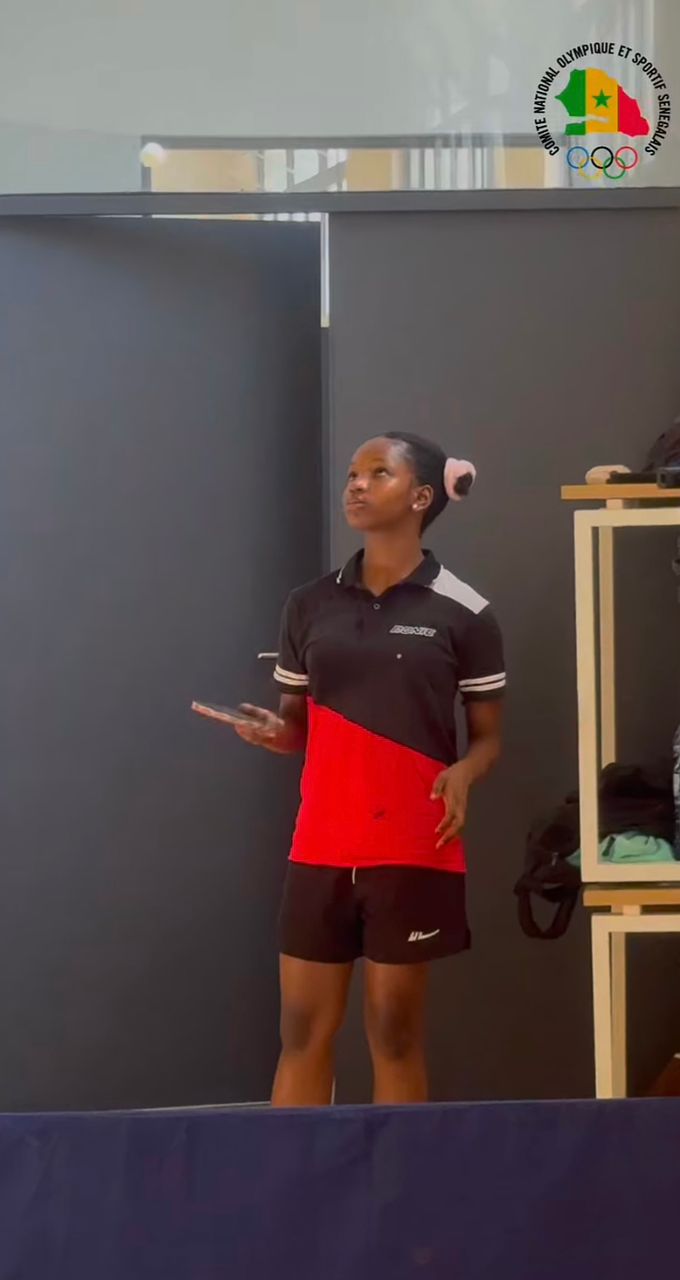
Marieme preparing for the Youth Olympic Games.
Marieme Diallo did not grow up dreaming of table tennis. She found it at school, out of curiosity, the way most fifteen-year-olds find the thing that ends up running their life. Her uncle, Seikou Traoré, and a man named Pape Moussa Diack saw something and started guiding her. Her uncle is still her coach today.
When she tells people in Senegal that she plays, she gets the same reactions everyone in this article gets.
"Some people think it's easy, just hitting a ball. Others don't even know what table tennis really is." — Marieme Diallo
At first, only her parents believed in her. They took it as seriously as she did. Then she started traveling for the sport, and something changed in how they saw it.
"Once I began traveling, they started to get more involved. They realized it was something real and important." — Marieme Diallo
Her week is two sessions. Wednesday evenings at the KMTT club. Saturdays at the Léopold Sédar Senghor stadium. A training day runs until at least four in the afternoon, then home, a meal, a shower, whatever tasks are left, and rest. She is also a student, doing two full-time things at once.
Her coach once asked her to do something she still remembers.
"The hardest thing he asked me to do was play while the crowd was screaming at me, even though I have a deep fear of large crowds."
— Marieme Diallo
Hold onto that detail. A girl who is afraid of crowds, training for a tournament where the entire crowd will be Senegalese, screaming, for the first time in history.
China
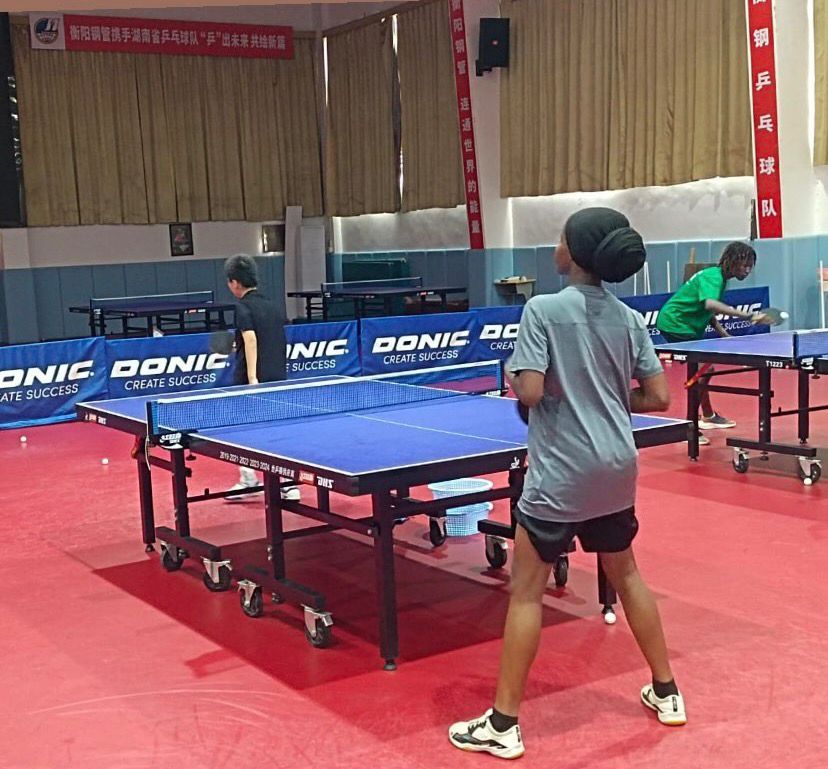
Marieme training in China, surrounded by world-class facilities and players.
Marieme was one of the six. Two months in China. Her first sports trip abroad. She came back with new methods, new habits, and one image she cannot shake.
"What shocked me the most was seeing children as young as three already training, sometimes late into the night. Despite their age, they are at a very high level. They can beat us easily, even the older players." — Marieme Diallo
This is what closing the gap looks like from the inside. Not a statistic about rankings. A teenager standing in a Chinese training hall, watching three-year-olds, doing the math on how far ahead the rest of the world already is.
Her equipment came from that trip too. A Butterfly racket she bought in China. One Butterfly rubber, one DHS. She has what she needs to play well. What she does not have, what none of them have, is opponents.
What Nobody Gave Them
The ITTF has a Participation Programme designed to help developing nations prepare for major events. Senegal will host the Youth Olympic Games. They received one training camp.
"We believe it was insufficient."
— Papa Anthioumane Diagne, President, Fédération Sénégalaise de Tennis de Table
Outside of the state's minimal support and the Olympic Committee, the federation funds itself. No major sponsors. No international partners stepping in. A country preparing to welcome the world to a sport it can barely fund at home.
The federation is doing what it can. Training camps during the school holidays. Programs to lift the level of daily practice. Marieme feels it.
"As the event gets closer, it becomes a bit harder to manage. We are also students, so it's not always easy. But we manage it with our coaches." — Marieme Diallo
What They Know
The players are happy. They are also clear-eyed. Marieme has never played an Asian or European opponent. She wants to, badly, even knowing how it would probably go.
"Even if I lose my first matches against them, I would still learn a lot. I truly admire them."
— Marieme Diallo
She saw their training hours in China. She knows the conditions in Senegal are not comparable. She is not pretending otherwise. Nobody in this program is.
What they have is this. Home ground. A crowd that will be theirs. A ceremony that will be theirs. A first match on African soil in a tournament of this scale, something that has never happened before.
"It will be the first time Africa has ever organized an event like this."
— Papa Anthioumane Diagne, President, Fédération Sénégalaise de Tennis de Table
The first time.
The Hardest Part
For Marieme, the gap in level is not the hardest thing about this sport. The hardest thing is being a girl who plays it.
"Many people judge you without really knowing you, just based on how you are dressed. Dealing with people's opinions and judgment about girls' sportswear is one of the biggest challenges." — Marieme Diallo
It is hard, she says, to be taken seriously as a female athlete. She keeps going anyway. The thing that makes it possible is the same thing that started it: her coaches.
"They always encourage us to move forward instead of bringing us down. They support and motivate us, and I am really grateful to them." — Marieme Diallo
What They Want to Show
When the world arrives in Dakar, the federation wants it to see something specific.
"A resilient people, a land of hospitality, and many young people who love sport despite having very little."
— Papa Anthioumane Diagne, President, Fédération Sénégalaise de Tennis de Table
Ask Marieme the same question and you get the same answer in a teenager's words.
"Senegal is known as the country of Teranga, and Dakar is the capital of Teranga. I want them to see a beautiful, extraordinary city, and to leave with a better understanding of how welcoming and special Dakar really is." — Marieme Diallo
Teranga is the Wolof word for hospitality. It is the thing Senegal is known for before it is known for anything else. The president and the fifteen-year-old, asked separately, both reached for it. That is not a coincidence. It is what this country has decided to lead with when it has little else to lead with.
After the Games
Marieme is not treating the Youth Olympic Games as a finish line. She wants to keep training. She knows the run-up to the 2028 Olympics will not look like this one. She talks about other competitions, about London, about becoming, in her words, one of the shining stars of Senegalese table tennis. And she has a dream she states plainly: to bring a medal back to Senegal one day.
In five years, she sees herself somewhere specific.
"In five years, inshallah, I will be in China, playing for one of their clubs." — Marieme Diallo
The same country whose three-year-olds frightened her is the country she wants to build her career in. She understands exactly where the top is. She is pointing straight at it.
And the games themselves?
"Just being pre-selected already means a lot. I hope to be part of the final selection. We are training very hard, and I am not going to give up." — Marieme Diallo
Before the World Arrives
The first match of a Senegalese player at these Games will mean something a scoreboard cannot hold. Not because they are expected to win. Because they are expected to host.
Marieme found this sport by accident. She trains twice a week. She is afraid of crowds. She has never faced the kind of players she is about to share a venue with. And when a younger girl in her neighborhood asks her tomorrow whether she should start playing, she already knows what she will say.
"Make sure she has a good coach, like mine. Tell her to believe in herself, to have confidence, and not to let comments bring her down."
That is the whole program, really. A good coach. A little belief. Somebody who refuses to let the comments win. Senegal built its table tennis on not much more than that.
When the world arrives, that is what it will be looking at.
Dakar 2026. One nation. A table tennis story built on resilience, hope, and Teranga.
— The Dispatch —
Every story, first.
Get the latest table tennis stories, player profiles, and advocacy updates delivered to your inbox.
We respect your privacy. Unsubscribe at any time.