On a work day, Taima Abu Yaman does not go home.
She finishes her shift at the Public Security Directorate, gets in the car, and drives straight to Sports City. Home is where the rest would happen, the couch, the slow afternoon, the easy excuse to do less. So she skips it. She goes to the hall instead, and she gets there an hour before practice starts, alone, to stretch before anyone else arrives.
She is 28 years old. She has done some version of this for twenty-one years.
Taima is the best female table tennis player in Jordan, and has been for years. She is also a full-time government employee with an accounting degree from the University of Jordan. Neither of those two lives leaves much room for the other, and she runs both at once, every week, without letting go of either.
If you want to understand table tennis in Jordan, her schedule is a better place to start than her medals.
The Family
Taima's father is Captain Yousef Abu Yaman. He coached at the Orthodox Club in Amman when his children were small. Her older brother Zaid played there first. Her sister Sawar followed. Taima, the youngest, came along because they did.
She was seven when she picked up a racket. Her father watched her for a while and saw a gift the others did not have. Her mother started making sure she trained every single day. Within a few years she was on the club team. Shortly after, the national team.
When the three of them played friendly matches as kids, Zaid and Sawar would let her win, because she was the youngest and they did not want her upset. The two who handed her those early wins now train beside her on the national team, where nobody hands anybody anything.
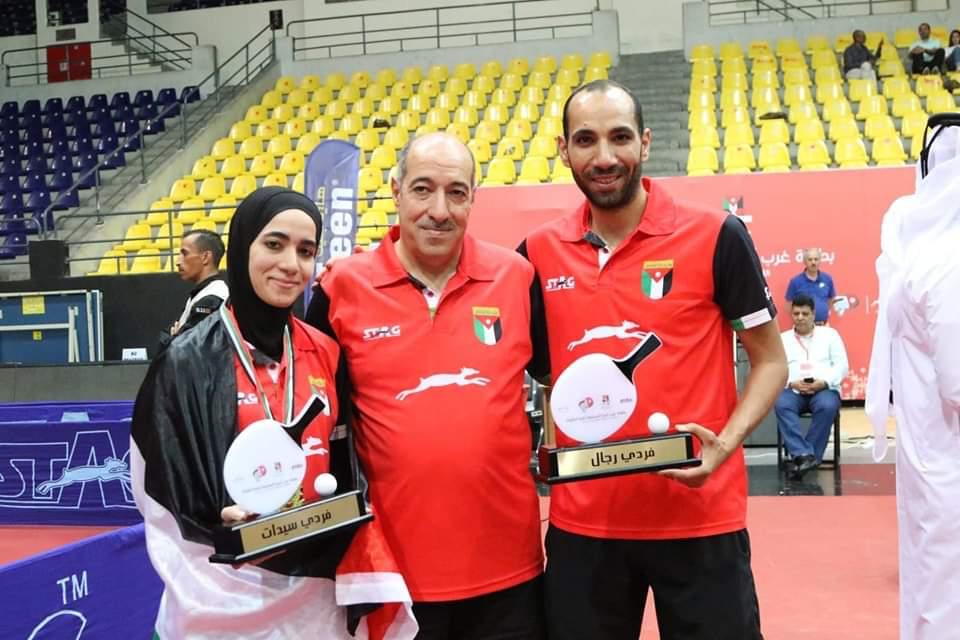
Taima and Zaid Abu Yaman after winning the women's and men's singles titles.
This, Taima says, is how the sport works in her country. It runs in families. Most Jordanian players arrive with a sibling, a cousin, or a parent who played before them, and you rarely meet one who came alone. Each player, in her words, drags their whole family into the sport behind them. Taima is the clearest example of her own rule, and her family is not a footnote to her career. It is the reason there is a career at all.
"There were moments of despair after losses," she says. "But when you're surrounded by a sports family, they don't let you give up. They become the reason you keep going."
— Taima
Double the Work
Here is what "double the work" actually looks like, because Taima uses the phrase and then lives it.
The national team session is two hours a day. For Taima, two hours is the middle of the day, not the whole of it. She arrives an hour early to stretch and warm her body in before the session begins, so that when the real training starts she is already moving. When it ends and the rest of the team leaves, she stays and stretches again, longer than everyone else, on purpose. Her reasoning is plain. A stiff or injured body cannot train tomorrow, and she intends to still be training years from now.
Then there are the work days, when the office comes first and she drives to the hall straight from her desk with nothing in between.
"If you want to be extraordinary, you have to put in the effort," she says.
— Taima
For her that line is not a slogan. It is the hour before practice and the extra stretching after, and it is the drive she makes when she has nothing left.
She has been doing this arithmetic on her own body for twenty-one years, adding the hour nobody scheduled, because the scheduled hours were never going to be enough by themselves.
A Woman's Time
Ask Taima about being a woman in Jordanian table tennis and she does not describe a closed door.
"There is gender balance," she says. The girls get the same attention and the same opportunities as the boys inside the program. The men's level runs higher, she will tell you, the way it does in most countries in the world. But the support, in her experience, is shared.
The harder part is not the federation. It is time.
Women, she points out, often have less of it to give the table. Family and home take a share that the men around her simply do not carry. And Taima is now living the exact tension she describes. She got married recently. She is a wife, a full-time employee, and still the number one player in the country, and all three of those want the same hours of her day.
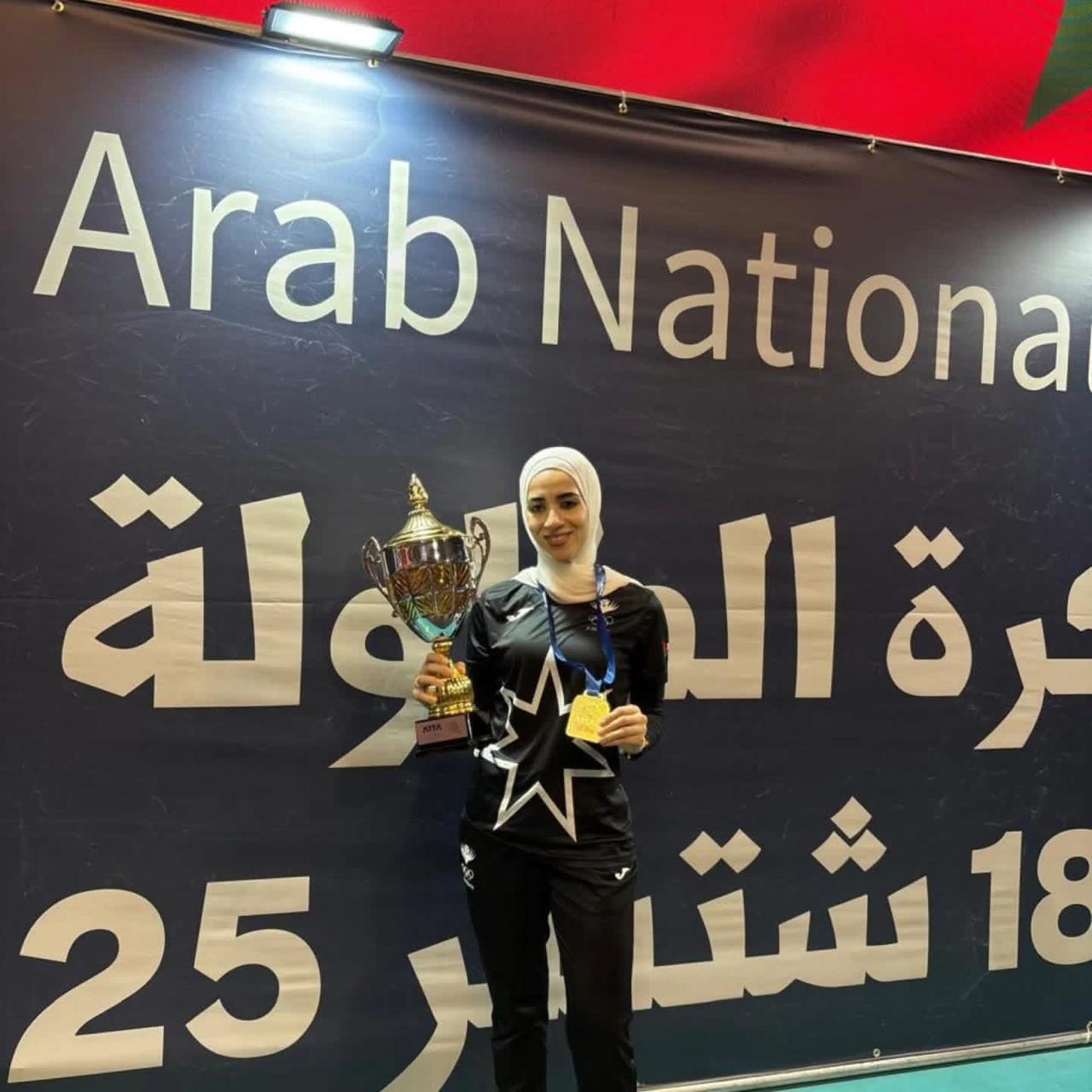
Taima at the Arab Nationals, still holding down the number one ranking in Jordan.
So far she has refused to surrender any of them. The schedule she built years ago, the one that kept her at the top of her class while she trained daily, is the same skill she now uses to hold a marriage, a career, and a national title in the same week.
She has not poured all of that effort into her own results alone. For a stretch she coached privately, and she watched young girls fall for the game the way she once did, their families lining up behind them in the familiar Jordanian pattern. She wants to be for one of them what one woman was for her.
"Her Highness Princess Zeina Al-Rashid," she says, when I ask who she looked up to.
— Taima
Princess Zeina sits on the ITTF Board of Directors. For a girl in Amman watching her father coach at the Orthodox Club, that was proof a Jordanian woman could run the sport, not only play it. Taima wants a girl watching her now to believe the same thing.
The Roster
Years ago, before she was the name at the top, Taima trained for months toward an Olympic qualifying squad. Her name was on the list. She had spent six, seven months pointed straight at it.
Then, before the qualifier, her name came off. A coach had judged another player ahead of her.
It landed hard. She had built that whole stretch of work around a place that was suddenly no longer hers, and she could have read it as a verdict and stepped back.
She read it as a target instead. She did not push back against the decision. She trained. She set out to make herself impossible to leave off a list, and by her own account that is the period her game jumped. The removal picked her ranking up and moved it.
She earned her own shot at qualifying after that. And at the top of the climb she met a different kind of wall, the kind no amount of personal work can push through alone.
The Ceiling
West Asia Olympic qualifier. Semifinal. A place at Paris 2024 on the line. Coach Amr Reda at the table, Zaid (Taima's brother) in the stands with the rest of the team.
She was up 10-8 in the first set. She lost it 12-10.
"When I lost the first set after I had been ahead, I lived a moment of fear and frustration," she says. "But with my brother Zaid there, he was my biggest support, I didn't stop. I came back to the match and fought to the last point. But luck wasn't with me that time."
— Taima
She lost the match 4-2, most of the sets close. Then, with no time to absorb it, she walked to the stands, because Zaid had his own qualifier next, and she became his support the way he had just been hers. He qualified.
"His win felt like it made up for my loss, and more."
— Taima
That match is where the ceiling stops being a word.
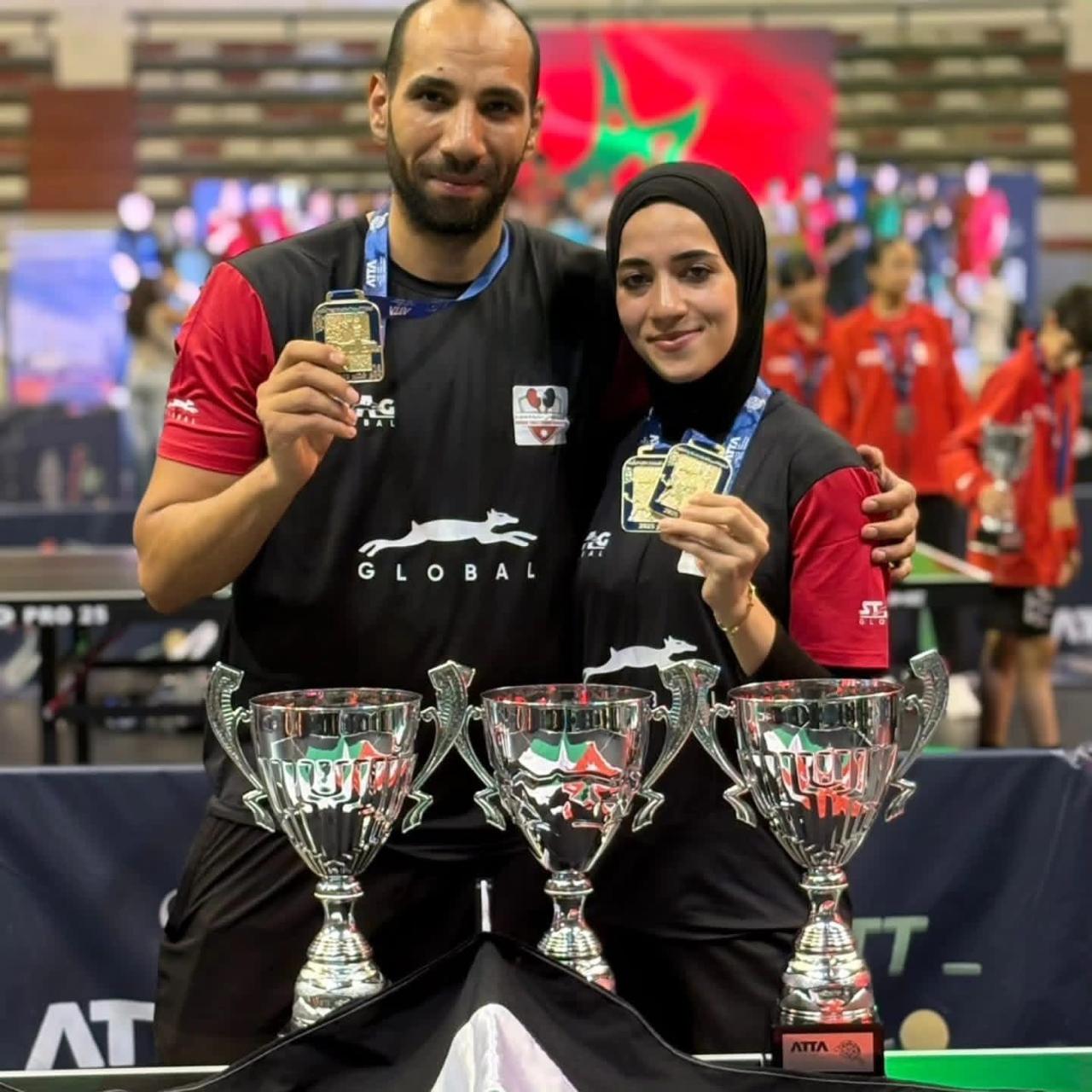
Taima and Zaid — the sibling who once let her win, and now shares a locker room with her on the national team.
When Taima loses to a player from Egypt, Europe, or China, she does not see a gap in talent. She sees a gap in tables. The players who beat her have spent years in rooms she rarely gets into, with constant international competition and training bases abroad, against sparring partners she almost never faces.
The numbers are blunt. Taima gets two or three international competitions in a year. She wants four or five. She has never once had the chance to apply for an overseas scholarship or training base, the exact thing that builds the players standing across the net from her. Inside Jordan the federation covers everything; the year is planned, the needs are met. The wall is the budget for going out, and that wall sits higher than any one player.
"Every country has different resources, and that affects the level," she says. "A player has to program herself with what she has, and put in double the work in training."
— Taima
She has even built a mind for the shortage. When she draws an opponent who is clearly better, she does not tighten up. She relaxes, because a match against someone above her level is the rare thing she runs short on, and she would rather use it than fear it. If anything, it motivates her to play even better.
If she had one wish granted tomorrow, she told me, it would not be a training camp. It would be more competition. Camps sharpen what you already have. Tournaments are where the level is actually built, and they are the thing she keeps running out of.
What She Would Spend It On
I asked Taima what she would change if the federation were hers to run.
She did not reach for prize money or stars. She went to the bottom of the pyramid. Youth. Grassroots. Finding talented kids early and building something real for them to grow into, so the game has a future and not only a present.
The federation is already moving that way, working to spread table tennis into every governorate in the country, into places that have never had a table. Taima sits at the top of the pyramid, and she would put the money into the base, the part she will never personally benefit from.
That answer tells you the kind of player she is. The ceiling above her is real, and rather than ask only for a ladder over it, she is asking for more children underneath it.
The Next Girl
There is a ten-year-old in Amman right now holding a racket for the first time, almost certainly because someone in her family already plays.
Taima knows precisely what the road ahead of that girl will ask. She has walked all twenty-one years of it: the early hour nobody scheduled, the drive from work with nothing left, the name once taken off a list, the ceiling that effort alone will not break. Asked what she would tell the girl, she does not recite the costs.
She tells her to start.
The youngest player at the Orthodox Club once won because the older ones let her. She is not the youngest anymore. She is the one the younger players watch, the name they are climbing toward, the player a whole generation is quietly being built beneath.
She was up 10-8. The set got away. The dream did not.
Taima Abu Yaman is the number one female player in Jordan. The ceiling is still up there.
She is still doing double the work.
— The Dispatch —
Every story, first.
Get the latest table tennis stories, player profiles, and advocacy updates delivered to your inbox.
We respect your privacy. Unsubscribe at any time.