
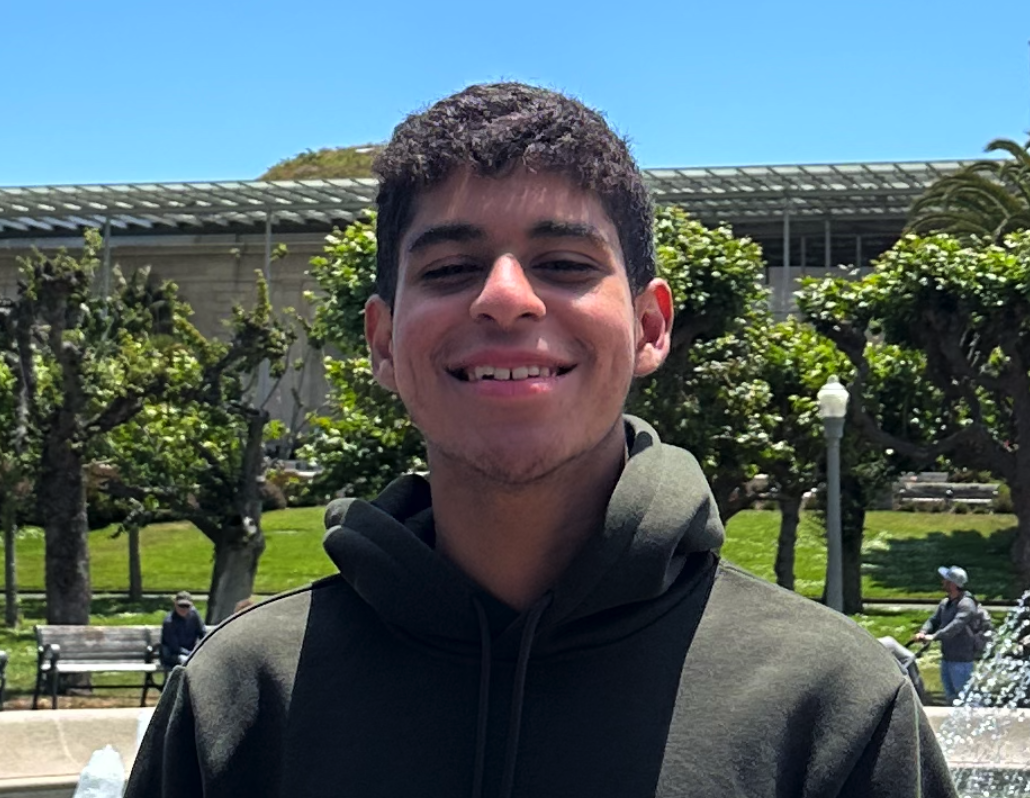
Vikram Singh has been ranked number one in Zimbabwe for over two decades.
He does not think he has been successful yet.
"Success in table tennis means that I have played my best. It is not about winning or losing — as long as I exhausted all my ability in playing, that makes me a successful person. For me, it is being able to express myself fully through sports."
— Vikram Singh
By his own definition, the most decorated table tennis player in Zimbabwe is still chasing it. At 50 years old. With two ranking-tournament losses in 22 years.
That tension — between what success looks like from the outside and what it feels like to the people inside — is the real story of Zimbabwean table tennis. The federation has over 2,000 active players. There is no NCAA pipeline. No million-dollar contracts. Almost no international exposure for the players who stay in the country. With no external markers to measure against, everyone in the sport has had to invent their own definition of what success means.
Sand Smash spoke to four people across the Zimbabwean table tennis scene. We got four different dreams.
Tinotenda's Dream: To Prove It Wasn't Nothing
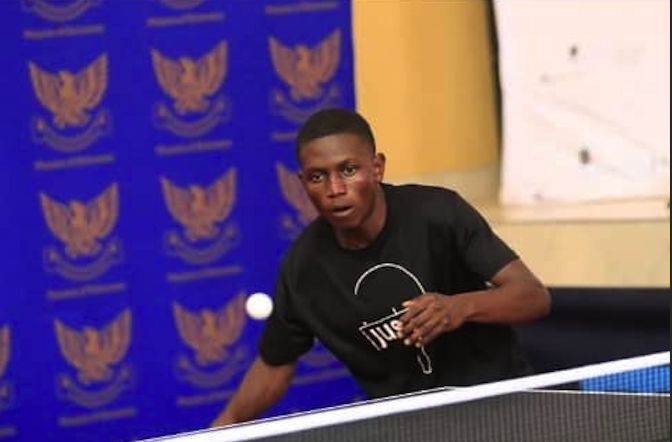
Tinotenda Phil Fambira — first to beat the defending champion at 14, now training four times a week and chasing China.
Tinotenda Phil Fambira was 10 years old when he started in 2013. His older brother Andy introduced him to the sport. Andy quit in 2019. Tinotenda doesn't know why.
He kept going.
By 14, he had become the first player to beat the defending champion, Vikram Singh, and was ranked number one in Zimbabwe. He trained at Old Windsor Primary School in Ruwa, sponsored by Edward Tsai, one of the school's major shareholders. Now, in his early twenties, he trains four times a week at Golden Peacock, a Chinese-run hotel in Harare where he meets Chinese players passing through. He has been to China twice. He came back more advanced, mentally and physically, than the players he left behind.
But the journey was lonely. The community at school respected him. The federation respected him. His family, he says, did not believe in it the way he needed them to.
"Imagine a young boy looking out for himself. I would go to tours (Zambia, Botswana) without pocket money while my teammates had everything. But I managed to be mentally strong and keep it going."
— Tinotenda Phil Fambira
For Tinotenda, success has two layers.
The first is concrete. A scholarship in China. A spot in the Chinese league. A way to earn a living from the sport that has cost him so much. Five years from now, he sees himself playing professionally in China.
The second is heavier.
"By this time I wish I could be somewhere else. Sometimes I really do not know where I am going. It's like I am afraid all this time could be nothing at the end."
— Tinotenda Phil Fambira
Success, for him, is the absence of that fear. It is the proof that all the pocket-money-less tours and lonely years added up to something. He needs the closure of knowing he made it out.
And before his own dream is realized, he has already started building what comes after. He coached an 8-year-old for two years. The kid went to China with him.
"I feel like I am a genius. Why? I coached an 8-year-old in two years and he managed to also go to China with me."
— Tinotenda Phil Fambira
He wants to start a club one day. Help his family. Encourage new kids to follow their dreams. Even while still chasing his own version of success, he is making sure another kid in Zimbabwe doesn't have to fight the way he did.
Vikram's Dream: To Play Someone Better
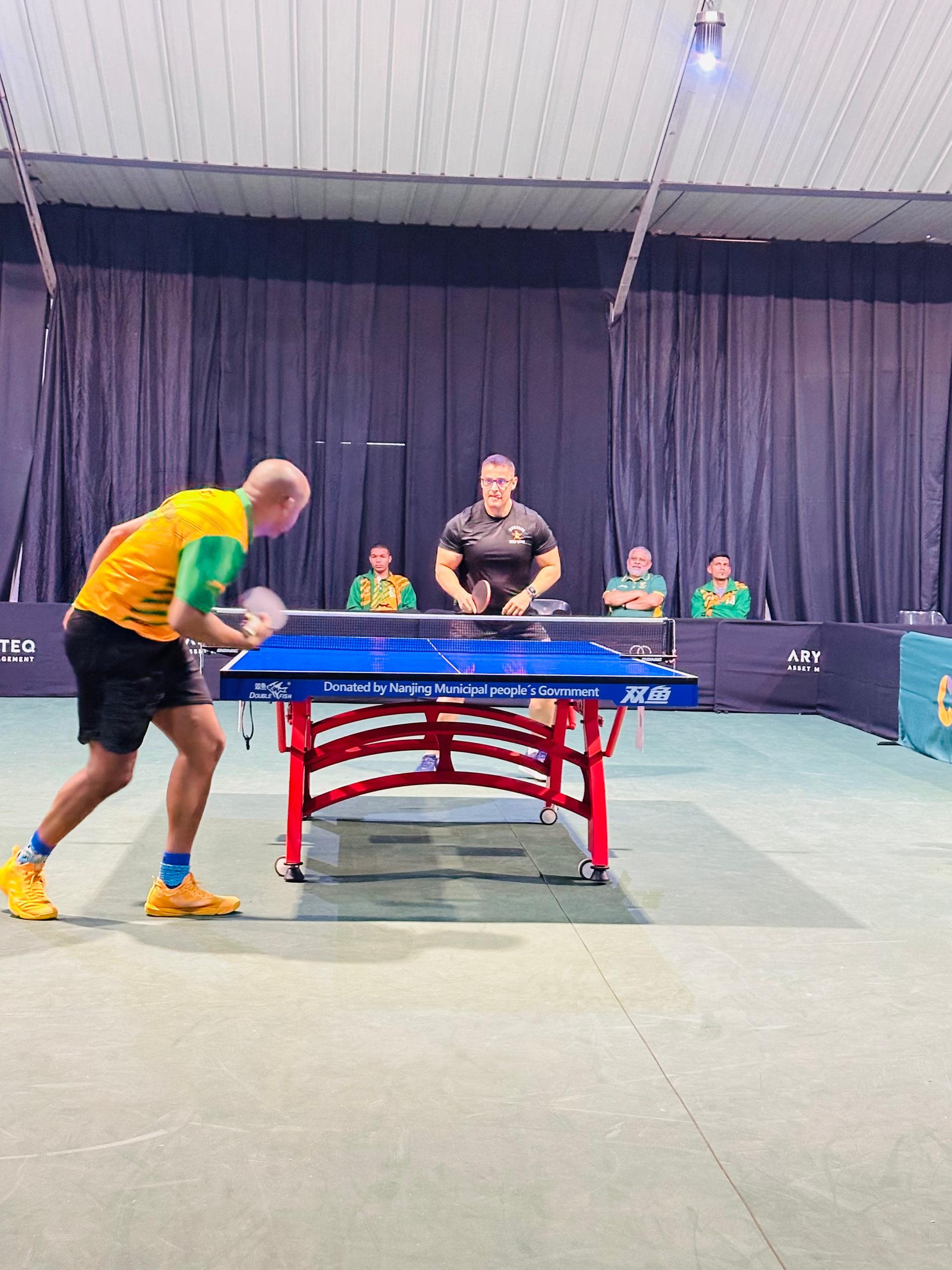
Vikram Singh — number one in Zimbabwe almost every year since 1993, two ranking losses in 22 years.
Vikram Singh is 50 years old. Indian by birth, Zimbabwean by citizenship since 2015. He moved to Zimbabwe in grade 8, in 1988, and started playing with old bats he found at his school.
By 1993, he was ranked number one in the men's category. He left in 1995 to study in India for ten years. When he came back in 2004, he picked up where he left off. He has been ranked number one almost every year since. Two losses in 22 years.
He has never had a formal coach. A handful of sessions in 1995. Everything else is hunger.
"There is a Chinese player who is 63 or 64, who has the same passion I have. We wake up at 5:00 AM and play for five hours."
— Vikram Singh
For Vikram, success is not measured in trophies. He has won almost every domestic tournament in the country. The trophies stopped being the thing a long time ago.
"What I would really like — my wish list — is to play someone better than me. I am constantly playing players I can beat. When you go out, you find out where you actually stand."
— Vikram Singh
That sentence is his definition of success. It is the absence of the ceiling that being number one in Zimbabwe has trapped him under for two decades. Vikram is not afraid of losing. Losses are wisdom to him. The bad times are the best times, he says, because they push him to ask the next question.
"People generally say good times and bad times. But it's bad times that give you the best wisdom. They are not bad. They are the best moments — because they take you to the glory."
— Vikram Singh
The problem is that he has run out of bad times. Nobody at home can give him a real loss. The two he has taken in 22 years are not enough.
His dream is the rest of his life on a table.
"Five years from now, even if my knees break, you will still see me on a table — with crutches or a wheelchair — still trying to hit the ball. The person who has nothing to lose is a dangerous person."
— Vikram Singh
Success for him is expression. Sustained, lifelong expression of the sport he chose. Not a medal. The act of playing.
Coach Brian's Dream: The Day His Kids Beat Him
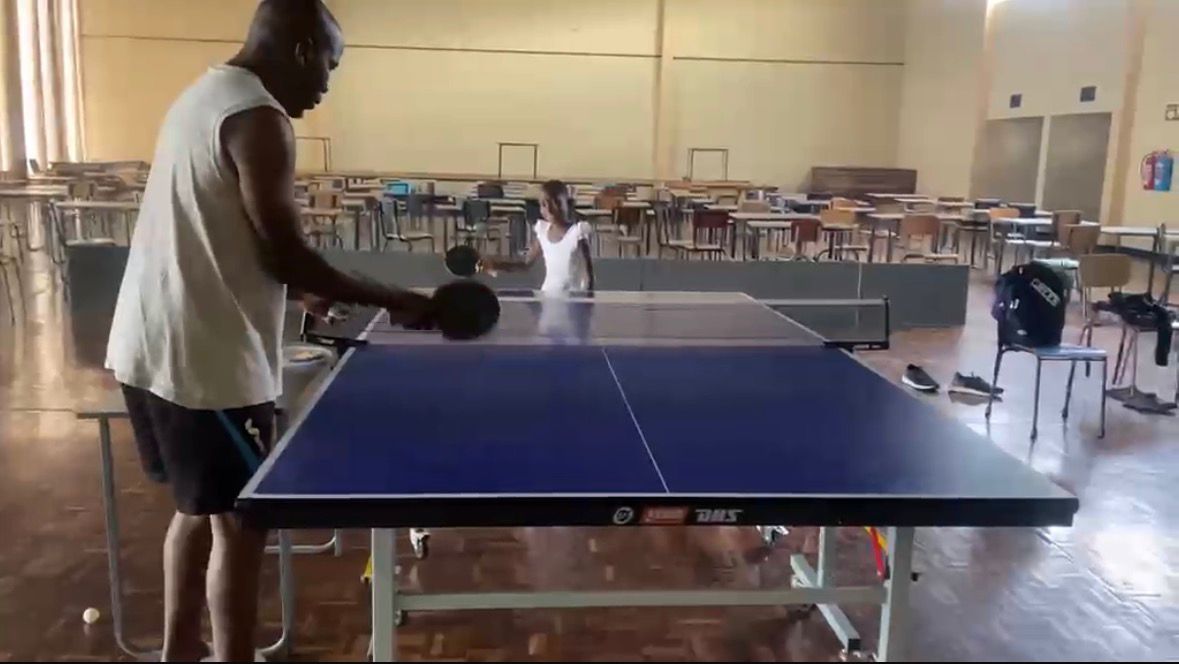
Coach Brian — left the financial sector to coach full-time, runs a school program, an academy, and Zimbabwe's national junior team.
Brian played competitively for over 25 years. Then he left the financial sector to coach full-time.
"It's a lifestyle. A passion. It's in the DNA. I had to leave the financial sector so that I do what my heart desires."
— Coach Brian
He coaches three tiers of players now. About 30 girls at the school where he teaches. 23 kids at his own academy, sheltered within the school grounds. And as Zimbabwe's National Junior team coach, he runs outreach programs to identify talent in less privileged communities — the same communities the federation cannot afford to reach formally.
If you ask him to describe success in institutional terms, he gives you the answer a federation would frame on a wall.
"Podium finishes at continental and international events, and the ultimate prize of landing scholarships to Asia or Europe."
— Coach Brian
But that is not the answer he tells with his eyes. The real answer is a story about a boy on a rugby pitch.
The kid wanted to play rugby. Brian saw him moving and saw something else. Reaction speed. Coordination. The kind of body awareness that does not come from the field but from somewhere deeper. Brian convinced him to try table tennis.
The kid bought in. He trained. He got good. He got better than good.
Then, one day at a tournament, he beat Brian.
"He at one event went on to beat me. The boy now is a man and I'm proud of him."
— Coach Brian
That is the sentence. That is Coach Brian's definition of success.
A player Brian found, on a rugby pitch of all places, became good enough to defeat the man who saw him first. That is what Brian wants. Not for himself. For his students. The moment the kid no longer needs him. The moment the lesson becomes the player. He wants to keep producing those moments — on rugby pitches, in school halls, in the outreach communities he visits with borrowed equipment — until Zimbabwe has so many of them that no single player has to carry the country alone.
The conditions don't make it easy. Tables are scarce; the club recently acquired some from China and still needs four more. Rackets are the bigger problem — Brian wants top-of-the-range equipment for his elite athletes and beginner sets for the outreach kids who have shown the desire to be part of the sport. Convincing parents is its own battle.
"You have to be pro-sport and pro-educationist to have kids allowed to partake in sport."
— Coach Brian
He has lost players. Other sports presented better options. Parents jumped ship for safer paths. Brian doesn't dwell on it. He says it the way a person says something painful that they have decided not to be defeated by:
"A painfully late go from my end. But it is what it is."
— Coach Brian
His dream is not for any one of his current students to become the next Vikram. It is bigger and humbler at the same time. He wants the kids in the national setup — and he insists every one of them is special, that he could not pick a favorite if asked — to keep arriving at that moment. The moment they no longer need him.
"Zimbabwe has got kids that can challenge for honors at any given time."
— Coach Brian
Brian's success is the day they prove him right. And then beat him to do it.
Noah's Dream: Zimbabwe on the Podium
Noah Ferenando is the president of the Zimbabwe Table Tennis Union. His definition of success is the most institutional of the four.
The federation has over 2,000 active players. Provincial Open Championships in every region. School leagues with inter-provincial competition. A corporate league for adults. Age groups from Under 10 to Open. Table tennis was selected as one of 13 sporting codes representing Zimbabwe at the Youth Games.
"Our definition of success is to see Zimbabwean athletes progress through structured development pathways, compete consistently at regional and international levels, and achieve podium finishes and global competitiveness. We are building toward producing world-class players who can represent Zimbabwe with distinction on the international stage."
— Noah Ferenando
The federation is implementing a Long-Term Athlete Development framework. Early talent identification. Structured grassroots coaching. Progressive competition exposure. Athlete tracking. On paper, it is the most complete vision of anyone in this story.
The funding does not match it.
"We currently receive little to no financial support, which remains a significant challenge for the development and expansion of the sport."
— Noah Ferenando
For Noah, success is not personal. He is not chasing his own podium. He is trying to build the conditions where Tinotenda's dream becomes reachable, where Brian's kids can get those scholarships, where Vikram doesn't have to leave the country to find a real opponent. The dream is to make the others' dreams possible.
What the Four Dreams Have in Common
Four different answers. The same sport.
Tinotenda wants the proof that all his pocket-money-less tours added up to something. Vikram wants someone who can beat him. Brian wants kids who outgrow him. Noah wants Zimbabwean players on international podiums.
What unites them is not the destination. It is the absence of any external system telling them what success should look like. Without scholarships, sponsorships, professional contracts, or consistent media coverage, success in Zimbabwean table tennis is something each person has had to define for themselves.
That is what the dream looks like in a country where the institutions cannot promise anything. It becomes intimate. Personal. Passed down only to the next person who walks into the gym and decides what they are going to chase.
The federation does what it can. The coaches do what they can. The players do what they can. None of them has the equipment, the funding, or the international competition that would make these dreams cleaner.
They keep showing up anyway.
"Zimbabwe has passionate and talented athletes, a growing and structured development system, and a strong commitment to the sport despite limited resources."
— Noah Ferenando
That is the sentence the federation president would put on a banner. The truer sentence is the one underneath it.
"It's like I am afraid all this time could be nothing at the end."
— Tinotenda Phil Fambira
Both are real. Both are happening at the same time. Zimbabwean table tennis is held together by people who keep dreaming inside that gap.
The dream is not yet real. But it is also not nothing.
From a 22-year-old who is afraid all of it might amount to nothing, to a 50-year-old who just wants someone better to play, Zimbabwean table tennis is held together by four definitions of success and the people stubborn enough to chase them. The talent is undeniable. The infrastructure needs to follow.
— The Dispatch —
Every story, first.
Get the latest table tennis stories, player profiles, and advocacy updates delivered to your inbox.
We respect your privacy. Unsubscribe at any time.