The hall is sold out, and over a thousand people are packed into a table tennis venue, which, if you play the sport, you know almost never happens. We play in near-silent halls in front of a few parents and some players from another age category. But this is different.
On the other side of the table stands a lineup most clubs would be terrified to draw: Fan Zhendong, the Olympic champion, and two more players ranked inside the world's top twenty. This is FC Saarbrücken, the reigning Champions League winners. On paper, it is not a contest.
But the crowd is not neutral. They are wearing black and yellow. They are loud. And when the last point lands, more than a thousand fans rise to celebrate a win. Not for a football team. For their table tennis team.
This is Borussia Dortmund. Yes, that Borussia Dortmund.
The Team You Didn't Know Existed
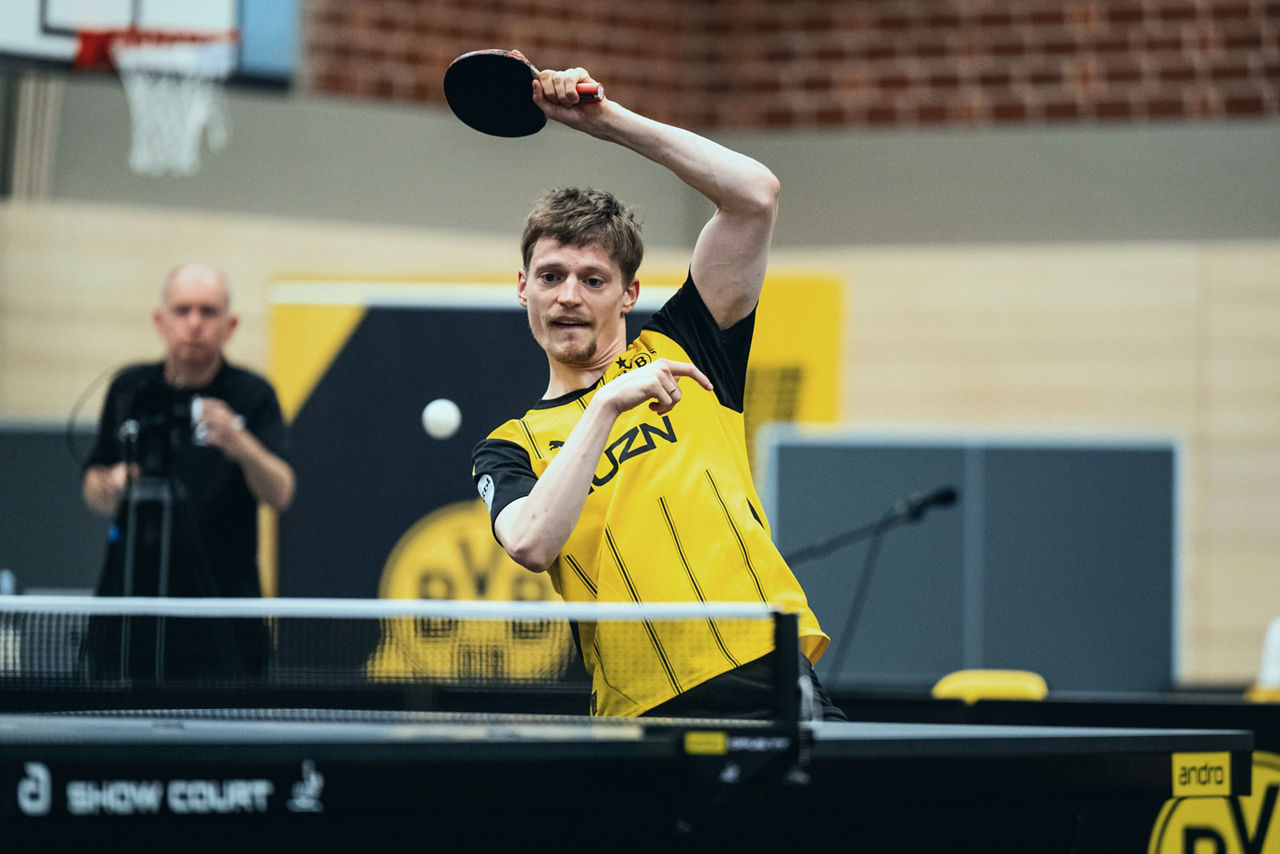
Most international fans know Borussia Dortmund for one thing: football. The Yellow Wall, the roar of Signal Iduna Park, the transfers, the trophies. What almost nobody knows is that under the same black-and-yellow badge, there is a table tennis section that has been alive for nearly 80 years.
It was founded in 1947. For around two decades, it played in the 2. Bundesliga, the second tier of German table tennis. Twice, the club had the chance to climb into the Tischtennis-Bundesliga (TTBL, Germany's top table tennis league and one of the strongest in Europe), and twice it said no. Not out of fear of the level, but because the resources to run a team at that level simply were not there. Then, in 2024, they decided it was time.
"In 2024 we decided for this big step up, and got all the support of the club and the KGaA."
— BVB Tischtennis leadership
That support was not only a budget to build a competitive team. It was the manpower to organize and run matches professionally, and, crucially for a publication like this one, professional support in the media sphere.
Not a Parallel World
When a small sport lives inside a football giant, the easy assumption is that it survives on scraps. A borrowed name, a forgotten corner, a division nobody in the main building thinks about. However, that's not really the case at BVB.
"Table tennis is fully integrated into our club. Although football is the main sport and core business of our club, our management is represented on the club's boards. We do not act in a parallel world, but are in constant communication with the leadership, the marketing, and all the other sections of the club."
— BVB Tischtennis leadership
I find this genuinely rare. My former club in Saudi Arabia, Al Nahda, shut down its table tennis division entirely and laid off everyone in it, because the sport was seen as minor and unprofitable. Clubs place us in the smallest halls. They do not support us with rubbers, etc. Table tennis is treated as the guest that overstayed its welcome.
At Dortmund, the table tennis section sits at the same table as everyone else. Literally, on the boards.
The Weight of the Badge
Wearing the black and yellow is not a free gift, though. It comes with a weight.
"Playing for Borussia Dortmund, no matter if football, handball, or table tennis, is definitely a huge challenge," the club explained. They describe BVB as the fifth-biggest sports club in the world, one that stands for top-class sport and, in their words, "passionate competitiveness."
"Wins are never guaranteed, but we always have the highest ambitions to fight for the possibility of winning each and every game we play."
— BVB Tischtennis leadership
Where the Money Goes
Resources are still limited, even at a club this size. So how does BVB Tischtennis decide what to fund and what to postpone?
The answer is refreshingly honest. First, the team. "A good team is the basis of any professional performance," they said. Everything starts there.
The next step is a home of their own. Right now the players train wherever they can, including at top facilities in Düsseldorf and Saarbrücken, where many of the world's best players practice too. But there are plans to build a dedicated table tennis and handball facility close to the stadium within the next three years.
For anyone who has read my earlier articles on infrastructure, you know why this made me sit up. In my region, entire cities of millions share two active clubs. Here is a club deliberately building a house for table tennis next to one of the most famous football stadiums on earth. That is what investment actually looks like.
The Most Underreported Thing
I asked BVB the question I always want answered: what is the one thing about your program that international readers would never guess?
The answer wasn't the crowds, the star signings, or the badge. It was about the kids.
"Maybe most readers do not know that we are probably the only club in Germany that educates their top players from the very early ages."
— BVB Tischtennis leadership
They gave me two names. Kirill Fadeev, who learned table tennis in BVB's own facilities and then led the team into the TTBL with a win in the final match of the second league. And Wim Verdonschot, who arrived as a teenager and will play for the TTBL team next season.
"Empowering our own young talents is a very important part of our philosophy, and connects us with the regional table tennis community and our city in a special way."
This is the part I love most. A club with the budget to simply buy a finished team instead chooses to grow its own, and lets a homegrown player carry it into the top flight. That is a promise to a city's children that the door is open, and a very important one.
The Coach: Evgeny Fadeev
The man coaching inside this football institution is Evgeny Fadeev. I expected him to talk about friction, about fighting for attention against the football machine. However, he did not.
"It's actually not difficult at all. We are two completely different sports. Football players do their job, and the table tennis players do theirs. What motivates me the most is that BVB is one of the biggest clubs in the world, and here the responsibility to achieve sporting success is especially high."
— Evgeny Fadeev
I asked him for a single moment that captured what table tennis inside this club is really about. He went straight back to that Saarbrücken night.
"They had the Olympic champion Fan Zhendong in their lineup, along with two other top-20 players in the world. Our venue was completely sold out, with over 1,000 people in attendance. In my opinion, this was one of the biggest moments for table tennis in the whole region. And the best part was seeing more than 1,000 fans celebrating a win for our BVB."
— Evgeny Fadeev
As a player who trains every day and is still, honestly, nowhere near (probably will never be) Fan Zhendong's level, I understand exactly how big that is. You do not beat a room full of Olympic and world champions by accident.
His advice for coaches in developing federations, from Zambia to Angola to Sierra Leone, was blunt and universal: every federation has different resources, but the players simply have to train as much as possible, and ideally train with different partners, including players from other countries.
The Player: Cedric Nuytinck
Cedric Nuytinck knows both sides of that Saarbrücken table. The former Belgian number one and a Champions League winner, he signed for Dortmund after his contract in Saarbrücken expired. What drew him in was the idea of building something new.
"I was very intrigued by the idea to play for a club which was new in the Bundesliga. When I arrived in Dortmund, I instantly felt how big the BVB family really is, and it really meant a lot to sign for black and yellow. The whole city breathes not only football, but the whole of BVB."
— Cedric Nuytinck
I asked him to walk me through a matchday, and his answer is one every player will recognize. You arrive the day before. You spend game day trying to relax, because the real stress arrives with the match in the evening. You warm up in the morning, eat a little breakfast and lunch, and about an hour before the match the team does its mobilization and a second warmup, while studying how to line up against the opponent. Calm on the outside, everything building underneath.
Then there is the gap. He plays at the very top of German table tennis, and most of the world does not know his team exists, like many aspects of our sport. I wanted to know what he thinks about that.
"We are slowly getting to the top 5 teams, and up there the margins are very small in winning or losing. I hope the audience will slowly recognize that BVB Tischtennis is also ambitious to consistently compete on a high level. More and more world-class players are getting interested in playing for our team, which is therefore getting better and better. I hope that people will soon recognize BVB table tennis, besides football and handball, also as top sport in our club."
— Cedric Nuytinck
The moment he wants a fan in another country to know about? The same one everyone at this club keeps returning to.
"Our home game in front of more than 1,000 people against Saarbrücken was simply unbelievable. We were able to win against a team of Olympic and world champions. That was incredible. I hope for more of these matches in the future, and we are doing everything to make this happen."
— Cedric Nuytinck
A New Chapter
Since reaching the TTBL, in their own words, everything has changed. "We are writing a new chapter of table tennis in Dortmund, presenting the world's best players here at least eleven times each year," the club said. Eleven times a season, in the city that breathes black and yellow, the best players on earth come to town, and a thousand fans come to watch table tennis.
Borussia Dortmund climbed into the top league to stay there. The plan is a home of their own, a steady climb toward the top five, and a pipeline of local kids who grow up believing that the black-and-yellow shirt can be theirs, paddle in hand.
The football team will always be the giant. But there is a table tennis team at Borussia Dortmund, and it is quietly becoming very good. Now the rest of the world just needs to look.
We're playing. We're winning. Now we want to be seen.
BVB Tischtennis. Founded in 1947. In the TTBL since 2024. Now selling out arenas against Olympic champions.
— The Dispatch —
Every story, first.
Get the latest table tennis stories, player profiles, and advocacy updates delivered to your inbox.
We respect your privacy. Unsubscribe at any time.