It is December in Rovaniemi, and the sun barely rises. By early afternoon the sky is already dark. Outside, the temperature sits somewhere between minus 20 and minus 30 degrees celsius. This is the edge of the Arctic Circle, closer to the North Pole than to most of Europe.
Inside a school gym, the lights are on. Five tables are set up. A group of kids is warming up, and the sound coming off the walls is the same one you would hear in Cairo, in Shanghai, in Lima.
Ping. Pong. Ping. Pong.
The club is called PT-60. It almost did not survive long enough to make that sound.
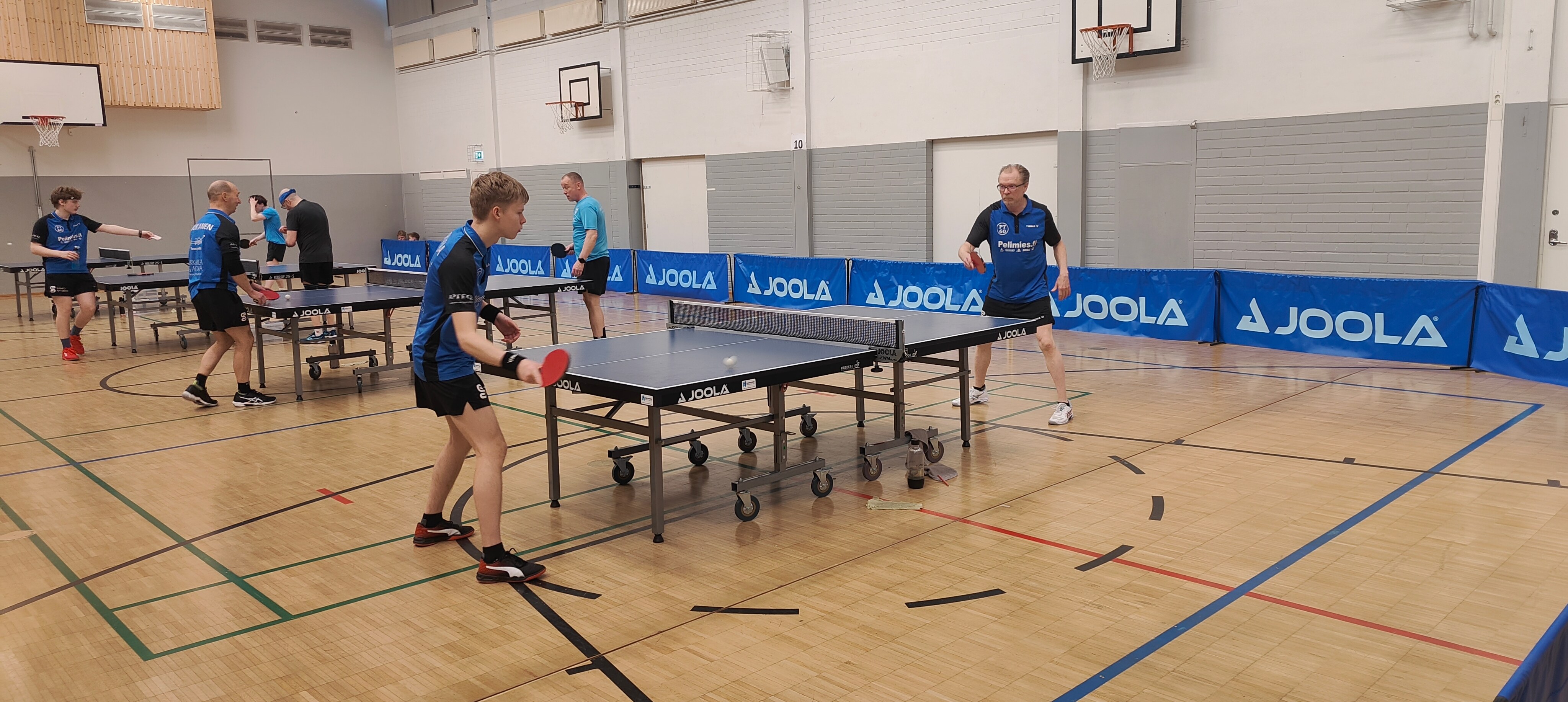
PT-60 players in competition, Rovaniemi.
The Northernmost Club
Rovaniemi is the capital of Lapland, in the far north of Finland. Life here is slower and more spread out than in the south. The winters are long, and for stretches of the year the daylight all but disappears.
In all of Lapland, only two table tennis clubs have really lasted. One is Kemin Pöytätennisseura, down in Kemi. The other is Rovaniemen pöytätennis -60 ry, known to everyone as PT-60. Two more clubs exist in the region, in Pello and Inari, but both were founded within the last two years. Everything else has come and gone.
The name is literal. PT stands for pöytätennis, the Finnish word for table tennis. The 60 is the year the club was founded: 1960.
Running a club this far north means accepting the distance as part of daily life. In southern Finland there are tournaments almost every weekend, often a short drive away. Up here, every competition means long travel, more planning, and more cost. As the club's president puts it, table tennis at the edge of the Arctic Circle comes with a rhythm of its own.
What Died
The founding year is in the name, but PT-60 has not been running since 1960 without a break.
In 1996, the club went dormant. Its president does not soften it. It was, in his words, a death blow. For more than two decades, PT-60 existed only on paper, and it was not clear it would ever come back.
Then, in 2019, it did.
For a short stretch before COVID, the club was thriving again, with just under 50 junior players. The pandemic ended that. After COVID, the junior numbers never fully recovered, and the momentum that had been so hard to build was gone.
That PT-60 still exists today is not something anyone here takes for granted.
One Person, Two Jobs
Kristian is the president of PT-60. He is also its head coach. In most clubs those are two different people with two different jobs.
He did not plan it that way. The club needed someone to step in as president, and the attention turned to him. Part of the reason was simple: he has been connected to PT-60 for a long time, having played for it since the early 1980s.
His own table tennis started somewhere unexpected. He first picked up the sport in Sweden, where his family was living at the time. After moving to Finland, he kept playing until he was about 18. Then he stopped. For 26 years, he did not play at all.
The sport came back into his life later, the way it does for a lot of people, and this time he stayed. Now he runs the club.
Doing both jobs, he says, does not actually take as much time each week as people assume, and he is not doing it alone. Others help keep things running. But the reason the roles pile onto one person is the same everywhere in small clubs: there are not enough active people willing or able to take on leadership.
Ask him what he cares about most as a coach, and he does not start with technique.
"My main hope is that the young players who come through our club grow into well-behaved, respectful people who treat other players properly, both on and off the table. If they also develop strong technical skills and become better players, that's a bonus. But character and respect always come first."
— Kristian
The Gym
PT-60 trains in the gym of a local school, where it also stores its tables and equipment. Each season the club applies to the City of Rovaniemi for evening slots, usually between 4:00 and 9:30 in the evening.
The city takes youth sport seriously, so training hours for junior players are free. For adult sessions, the club pays a small rental fee. Depending on how many people show up, PT-60 uses one of two halls: a smaller gym that fits five tables, or a larger main hall that fits eight. The space is clean and practical. It works.
The money is the fragile part. The club runs mostly on support from the city and from sponsors. Membership and seasonal fees cover the basics, things like facility rental and coaching. And there is one specific fear hanging over all of it.
If the city ever removed the free junior training slots, PT-60 would have to raise participation fees to cover the gap. Higher fees would push some kids out. Keeping junior table tennis affordable is the single most sensitive issue the club faces right now.
I have heard versions of this before. Not in Lapland, but in Saudi Arabia, where I play. Clubs I trained at shut down their table tennis programs when the funding math stopped working. The details change with the country, but the fear is the same. A club is always one budget decision away from disappearing, and the kids are always the ones who pay for it.
— Nasraldeen Moustafa
Kasperi
Kasperi Illikainen is 16. He started playing table tennis four years ago, after his mother found PT-60 on social media and he went to try a session. He never really stopped.
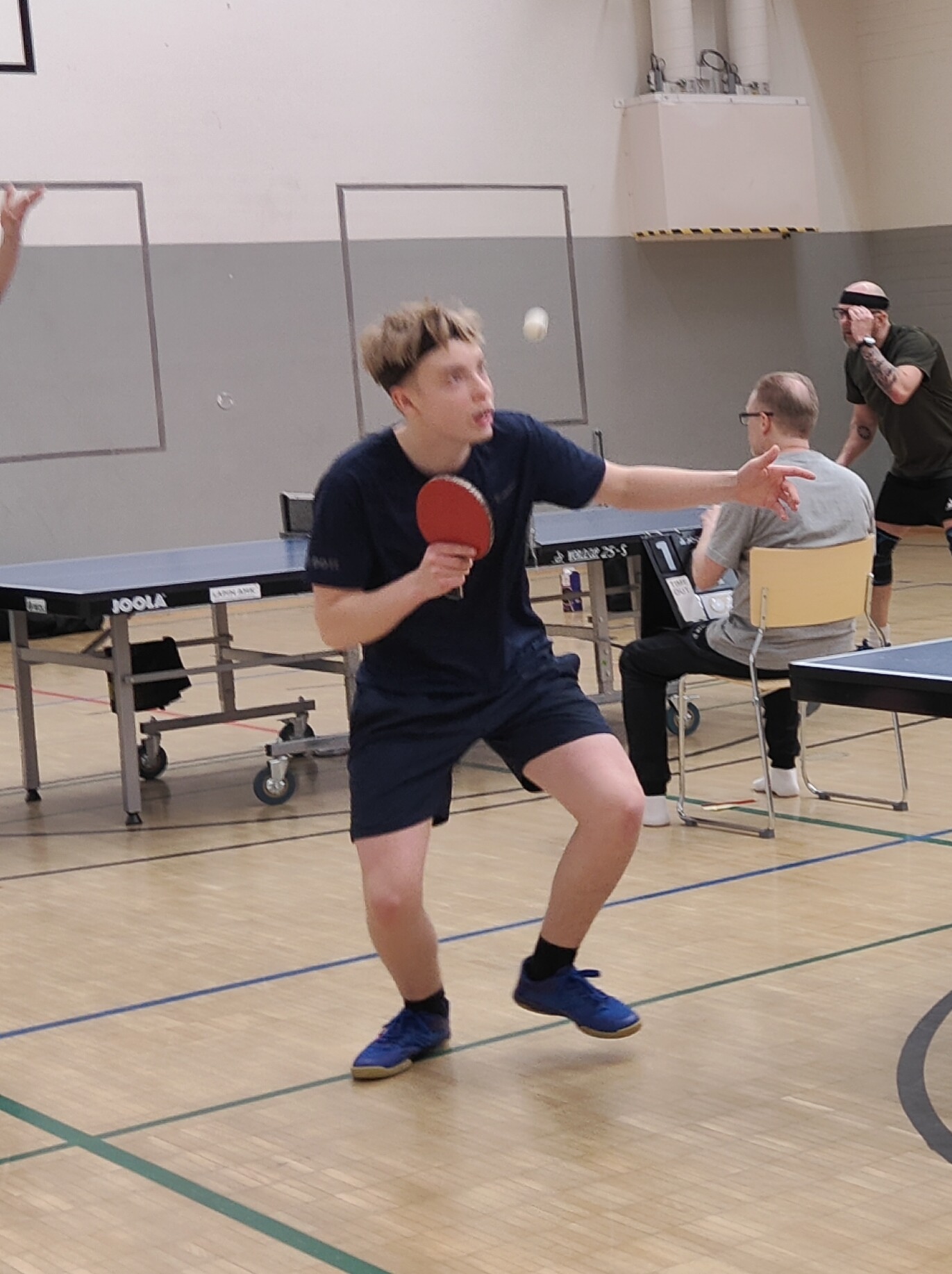
Kasperi Illikainen, 16, mid-rally.
He trains about nine hours a week in the school gym, working through drills and playing matches. Last season, something clicked. His rating jumped by more than 400 points in a single year.
That kind of jump is not an accident. Kasperi did not just train more. He trained with more structure. He started at a sports-focused upper secondary school, which now gives him table tennis sessions in the mornings once a week on top of a serious amount of physical and conditioning work. The school gave him a professional daily routine, and it showed in his game.
The travel is the hard part. From Rovaniemi, the nearest higher-level competitions are hours away. Kasperi says he travels anywhere from 3 to 8 hours to compete. He enjoys the trips, but they eat time, and he is honest about what would make his life easier: living closer to the action, and having more competitions in the north.
The nearest real hub is Oulu, a little over 200 kilometers south, home to one of the biggest clubs in Finland and a full-time professional coach. PT-60's juniors go there for training camps, where the sparring is deeper and the level is higher. It is the most realistic step up available. Anything further south happens rarely.
He knows what people in southern Finland do not always see. Being a table tennis player in Rovaniemi means the tournaments are expensive and far, and the coaching is not at the same level as in the south. Friends outside the sport do not really understand what competitive table tennis even is.
None of it has changed what he wants.
"My dream is to succeed at the national level someday. In five years, I see myself among the best players in Finland."
— Kasperi Illikainen
He is quick to spread the credit around. His teammates, his coaches, his family, and the club's adult players have all pushed him forward.
"We all support each other."
— Kasperi Illikainen
In a club this small, that is not a slogan. It is how the place runs.
The Ones Who Keep Showing Up
For all the focus on juniors like Kasperi, some of the most important people at PT-60 are the adults.
They are a loyal group. Most of them come to every session, week after week, year after year. Some played table tennis earlier in life and came back to it. Others found the sport only as adults. Most of them are over 50.
What keeps them coming is what the sport gives people at that stage of life. It is real exercise. It is mental focus. And it is a room full of familiar faces every single week. Competitive enough to stay interesting, flexible enough that no one feels the pressure of elite sport. For a lot of them, it is a genuine break from everyday routine.
There is also a running joke among the adult players, though it is only half a joke. They have read about how table tennis keeps the brain active, and how it comes up in conversations about slowing cognitive decline, even Alzheimer's. Given that most of them are over 50, they have decided, together, that they picked exactly the right sport.
The Arctic Circle Games
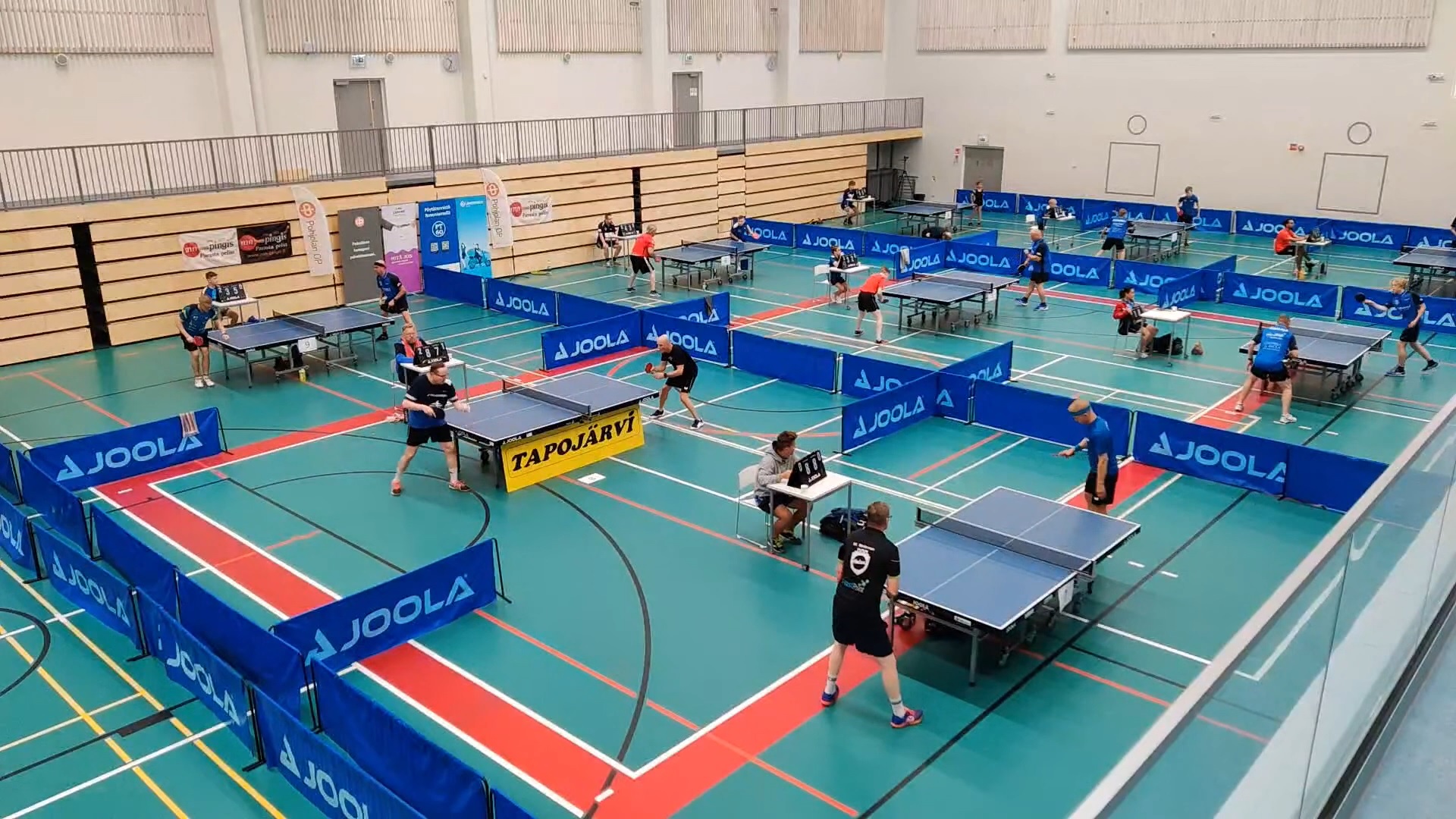
Napapiirin kisat, the Arctic Circle Games, in Rovaniemi.
Every year, PT-60 hosts a tournament called Napapiirin kisat, the Arctic Circle Games.
In 2025, it worked. The event drew 64 players from ten different clubs, and the club was happy with how it came together. In 2026, it did not go the same way. This time, PT-60 could not get enough players from other clubs to make the trip to Rovaniemi.
The timing was part of it. The tournament has traditionally landed around Christmas, which is peak tourist season here. Rovaniemi is marketed as the official hometown of Santa Claus, and in December the hotels fill up and prices climb. On top of that, 2026 brought an especially brutal week, with temperatures between minus 20 and minus 30. Several other tournaments were scheduled around the same dates, forcing clubs to choose.
So PT-60 made a decision. Starting now, the Arctic Circle Games move from January to early autumn, when travel and scheduling are easier and more clubs can actually come.
The Missing Half
One number at PT-60 is hard to ignore. Right now, the club has no girls among its junior players. There is one woman playing at the club, and that is it. Female participation is very low.
The club knows it, and does not pretend otherwise. Increasing the number of girls and women involved is something PT-60 sees as important for its future, not a box to tick. It is one of the clearest gaps between where the club is and where it wants to be.
The Pattern
Sand Smash has told this story before. Different country, different continent, different amount of money, but the shape is always the same.
A sport that the bigger institutions do not pay much attention to. A place far from wherever the sport is supposed to happen. And a small group of people who keep it alive because no one else will.
PT-60 is that story, set at the edge of the Arctic Circle. A club that went dark for more than 20 years. A president who is also the coach because there is no one else to do both jobs. A 16-year-old who drives up to 8 hours to play the sport he loves. A group of adults who show up every week partly to compete and partly just to be in the same room together.
The president said something that stayed with me.
"In places like Rovaniemi, a club isn't just about competition. It's about community, continuity, and giving people of all ages a place to belong."
— Kristian
Table tennis in Rovaniemi will probably never be big or visible on a national level. Everyone involved knows that. But as long as people are willing to show up and put in the work, the club has a reason to exist. That, in the end, is the whole point.
Which brings it back to that school gym in December. Outside, it is dark and it is freezing, and the nearest big club is a long drive south. Inside, the lights are on and the tables are set up, and the ball makes the same sound it makes everywhere else on earth.
Ping. Pong. Ping. Pong. At the edge of the Arctic Circle, a few people decided that sound was worth keeping. So far, they have been right.
If you run a club, a federation, or a program with a story like this one, reach out. Sand Smash is listening.
Images courtesy of PT-60.
PT-60. Founded in 1960. Dark for more than 20 years. Still standing at the edge of the Arctic Circle.
— The Dispatch —
Every story, first.
Get the latest table tennis stories, player profiles, and advocacy updates delivered to your inbox.
We respect your privacy. Unsubscribe at any time.