She is in the middle of a warm-up. A double flip into the foam pit, a routine she has done countless times before. Her whole life has been built on routines like this one. First running competition at two years old. Diving at six. Pesäpallo at seven. Always more than one sport at a time, always training toward something.
This time, something goes wrong. She lands on her neck.
Her spine breaks in two places, between the C1 and C2 vertebrae, and again lower down, between C6 and C7. It takes time before anyone finds her in the pit.
She survives because of where the break landed.
"I was lucky that my spinal cord injured from the lower C6–C7 level. If the injury would have been at C1–C2, I would not have survived, because it took time before anyone found me. A respiratory depression at that level would have been fatal."
— Aino Tapola
The year was 2012. Aino was a teenager who had spent almost every free hour of her life chasing one goal: Superpesis, the top league in Finnish baseball. She also carried a quieter dream she rarely said out loud, the Olympics, even though she knew her sports would never take her there.
Fourteen years later, Aino Tapola is the number one women's singles class 1 table tennis player on the planet. She is the first person to hold that ranking since July 2011.
This is how she got there.
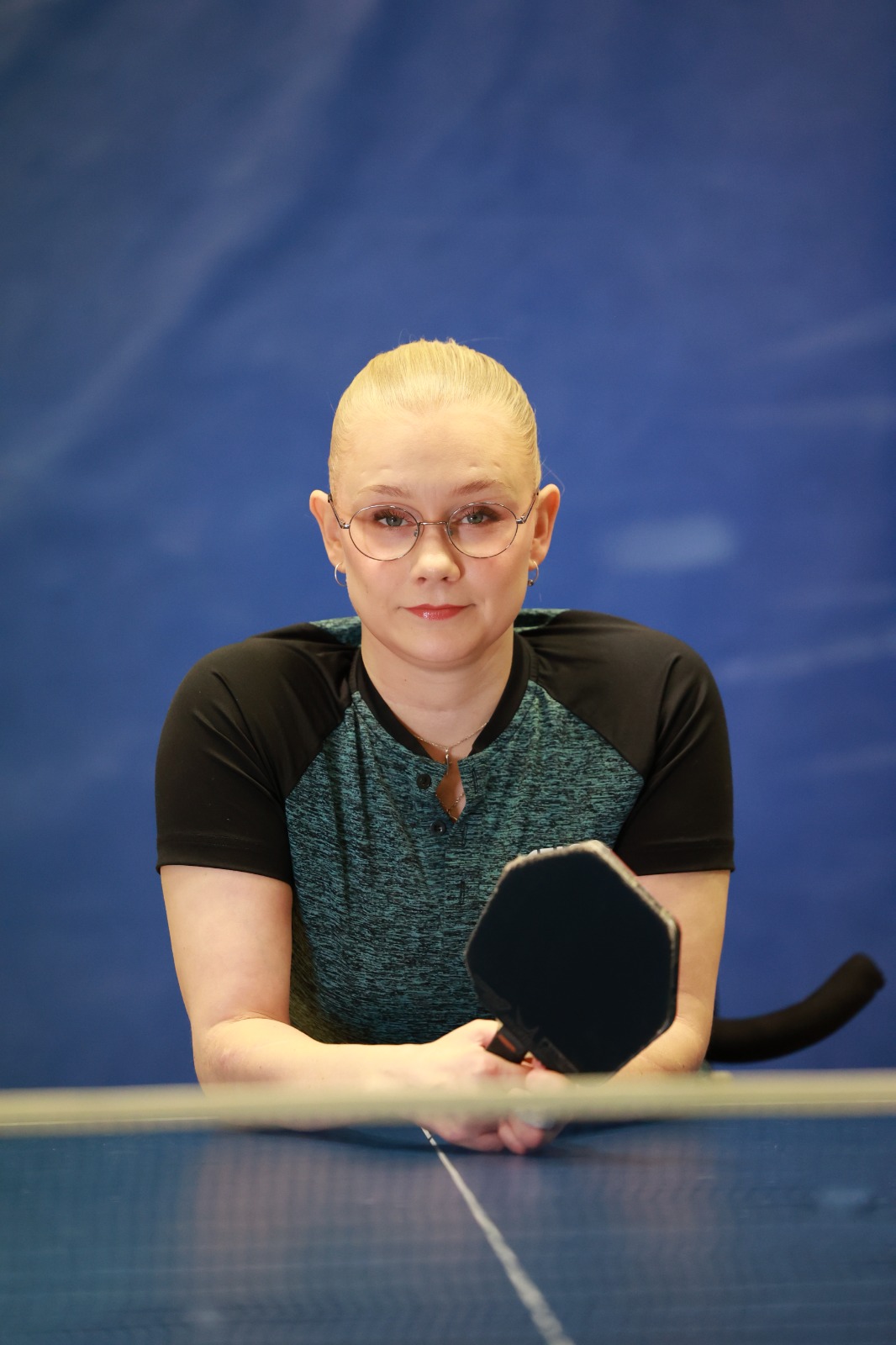
Aino Tapola. Photo taken by Harri Vallila.
The Year Everything Stopped
The hospital made the diagnosis quickly. Her quadriplegia, paralysis affecting all four limbs and the torso, caused by injury to the spinal cord in the neck, would be permanent.
Ten days in intensive care. A month in the hospital. Six months in a rehabilitation center.
"My condition during the first year was extremely poor. I was almost certainly depressed. My life no longer had any real meaning, because I had spent almost all of my free time on sports. I believed that being disabled would mean feeling miserable all the time."
— Aino Tapola
For someone whose entire identity was movement, the stillness was its own kind of injury.
Then came a detail that sounds almost too small to matter. A year after the accident, doctors discovered a hidden kidney infection. Once she finally received the right treatment, her health improved and her energy came back.
She started training three times a week at the accessible gym inside the rehabilitation center. One day a wheelchair rugby player saw her there and invited her to a practice.
That invitation was the beginning of everything that came next.
A Video From Rio
Aino played wheelchair rugby for years, including a few seasons on the Finnish national team. She loved it. It gave her friends, and it gave her peer support from people who understood her life.
But Finland is a small country, and there were never enough para-athletes to build a competitive national team. So she went looking for an individual sport instead.
She tried wheelchair racing. Fencing. Swimming. In none of them was there real competition within her disability class.
Then a friend showed her a video. It was the Paralympic bronze medal match from Rio, Rossi against Bootwansirina, two quadriplegic women playing table tennis. Aino was inspired on the spot. The rehabilitation center already had a table, so she and her friend started a small club right there and practiced once a week.
One of those sessions changed her life. A coach named Martti Autio came to watch. At the time he was working with Esa Miettinen, a class 9 player. In para table tennis, players are graded from class 1 to 11 by degree of impairment, with classes 1 to 5 for wheelchair athletes and 6 to 10 for standing athletes; the higher the number, the milder the impairment.
In the summer of 2017, a joint training camp was organized at the Ruskeasuo Sports Hall. Aino sat down with the coaches and asked what it would actually take to reach the top of the world. From that conversation, the ambition became real.
The old secret dream of the Olympics had a new home now. She could aim for the Paralympics.
She also fell for the sport itself.
"I liked table tennis because it's such an accessible sport. All you need at the beginning is a table, a racket, and a ball. Unlike many other para-sports, you don't need an expensive sports wheelchair in the beginning. I loved the tactical nature of the game, and the fact that I could compete and train with both disabled and non-disabled friends."
— Aino Tapola
Martti and Hannu
If you have read Sand Smash before, you know the story of the unpaid coach. The person who keeps the whole thing standing because nobody else will.
We found it at Yale, where Ahmed Elmallah and Fei Zhai drive two hours each way to coach college students for twenty-five dollars an hour. We found it in Peru, where families pay for everything because funding is very limited for U15 players. In Finland, the same story has two names. Martti Autio and Hannu Sihvo.
"Without Martti and Hannu, I would never have started competing in table tennis. They have coached me from the very beginning and believed that I could become the best in the world. They have also done an enormous amount of work outside of training, for example creating training programs and analysing my matches. I am deeply grateful for everything they have done for me."
— Aino Tapola
Both coaches were retired, which meant they could give her something most athletes never get: their full time. They worked together daily.
There is a reason this matters so much, and it goes far beyond Aino's career. In Finland, table tennis is a tiny sport compared to its global popularity, and the country faces a real shortage of coaches in both the able-bodied and para games. Because table tennis can be played for an entire lifetime, many players simply have no interest in stepping into coaching.
"Funding for para sports in Finland is limited, and there are very few paid coaches across all para disciplines. In some sports, none at all. Coaching is mostly done on a pro bono basis or for very minimal compensation."
— Aino Tapola
She does not say this with bitterness. She says it as a warning.
"In the future, this will inevitably affect Finland's success in para sports, as other countries have far greater resources available for developing coaching."
The world number one is built on volunteer hours.
The Climb
Aino developed fast, and she knows exactly why. "From the very beginning, I was practicing the right things," she says. Martti had coached male players in her classification all the way back in the 1980s, so the knowledge was already there. She did not have to waste years finding it.
In early 2020 she got a new wheelchair built specifically for table tennis, funded by a crowdfunding campaign. It cost 4,500 euros, and it was not a luxury. Playing from her everyday chair had started to cap her development. The higher, purpose-built chair lifted her game to a new level.
Then the pandemic arrived, and for Aino the timing was strange fortune. COVID pushed the Tokyo Paralympics back by a full year, which handed her months of extra preparation. After Finland's first total lockdown lifted, national team athletes were allowed back to train under restrictions, and Aino believes she trained far harder than most of her rivals during that window. She and her team did what they had always done, only more of it: hours of video, breaking down every opponent she might face.
It paid off at the Tokyo qualification tournament. Aino went in as the lowest seed in the competition and won it convincingly.
"It remains one of the greatest moments of my career."
— Aino Tapola
Tokyo
The qualification, not the Games themselves, is the memory she holds closest.
"In the early stages of my career, I often felt underestimated, and apart from my own team, very few people believed I could succeed in table tennis. Qualifying felt like true recognition for all the work my team and I had been doing since 2017."
— Aino Tapola
She became the first Finnish woman ever to play table tennis at the Paralympic Games.
Tokyo itself was muffled by the pandemic. Masks at all times. A COVID test every single morning. Empty stands where there should have been noise. Aino knew her odds of a top result were slim. The level was brutal, and she had to compete in the combined class 1 and 2 field, up against women with milder impairments than her own.
She lost both group stage matches and went out early.
"Of course, I would have wanted to perform better," she says. The disappointment was real. But she had done the thing she came to do. She had arrived.
A Class of Their Own
The next milestone was not a medal. It was a category.
At the 2022 World Championships in Granada, women's class 1, the category for the most severely disabled players, was held as its own standalone event for the very first time. For decades, these women had been forced to compete against opponents with significantly milder impairments. The men's class 1 had been separated for years. The women had not.
"This was a major equality issue."
— Aino Tapola
She understands why the class had stayed so small for so long. When athletes and federations do not believe a category can produce success, they stop investing in it, and the field shrinks until the doubt looks like proof.
So Aino and others pushed. They did not just win matches. They won the argument. Women's class 1 has now been included in the LA 2028 Paralympic program, and with official status, the numbers are already climbing.
"I believe that in a few years, women's class 1 will actually be larger than class 2. I am extremely happy that we've been able to bring about this change."
— Aino Tapola
This is the part of her story that will outlast every ranking. A player who fought to make sure other women like her would have a place to compete at all.
Paris
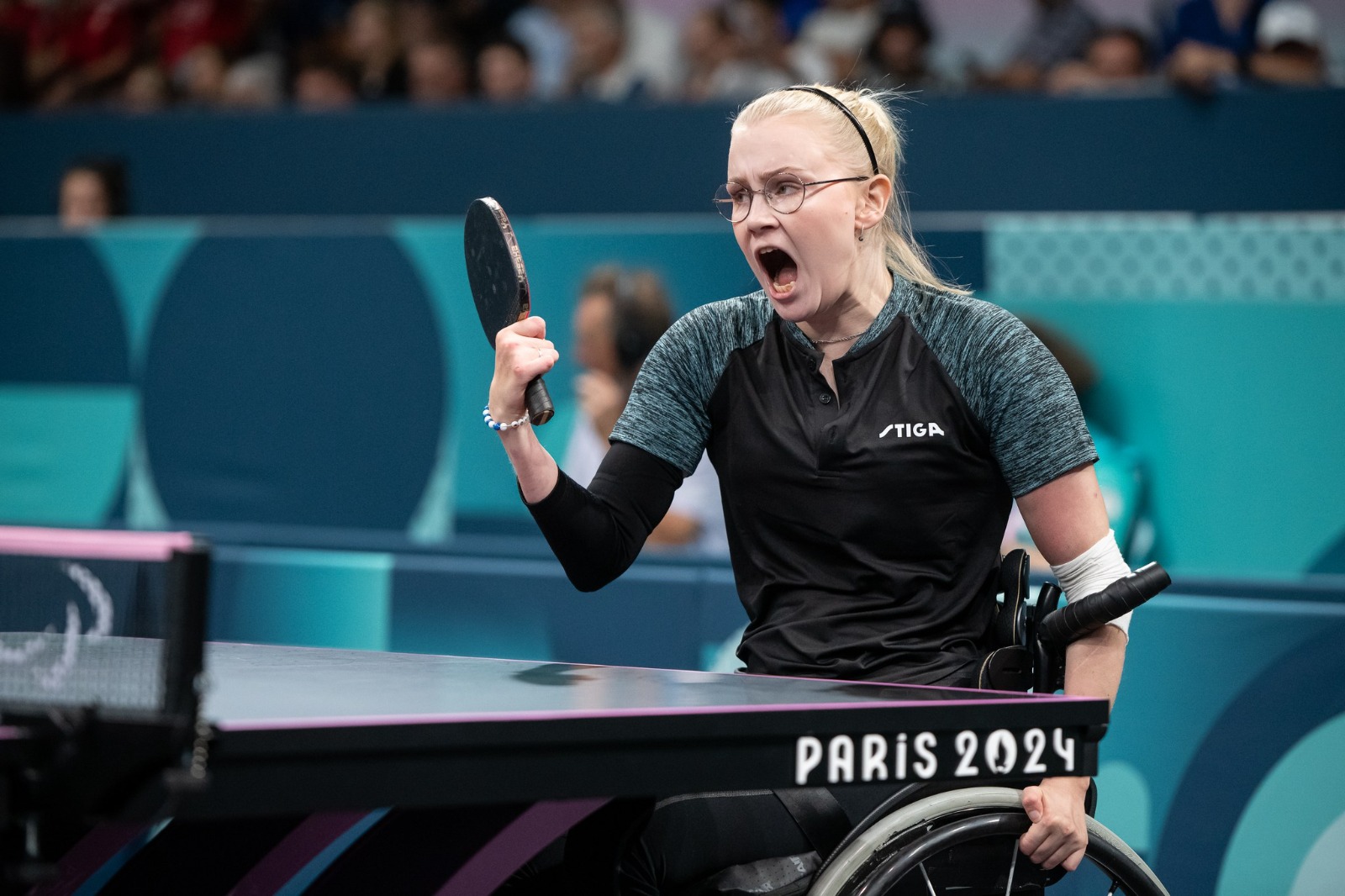
Aino Tapola at the Paris 2024 Paralympic Games.
By 2024, Aino no longer needed a qualification tournament. Her ranking points carried her straight into the Paris Paralympics.
She arrived hurt.
For more than a year she had been fighting a severe burn on her elbow. She has no heat sensation there, and one night in May 2023 she accidentally burned it on a hot water bottle without feeling a thing. The wound took five surgeries. It became infected more than once and needed intravenous antibiotics. It finally healed in December 2024, after the last operation. Along the way she cancelled competitions, took sick leave, and watched her ranking stall when she needed it to rise.
Paris changed its competition format too. In the first round, players ranked five through eight faced players ranked nine through twelve, with the winners advancing to meet the top four. Aino's plan was to land in that five through eight group and earn a softer opening match. She did not manage it.
The draw gave her Argentina's Coty Garrone, probably the hardest of the four opponents she could have faced. She lost three sets to none.
"It was the biggest disappointment of my career."
— Aino Tapola
This time she had not come just to be there. She had come to win.
But she remembers one thing about Paris that Tokyo never gave her.
"The atmosphere in the hall was completely different. The stands were full, and the noise level was incredibly high."
The world had started watching.
Fourteen Years
On June 25, 2025, Aino Tapola became the number one ranked player in women's singles class 1.
To understand what that date means, you have to understand the name it replaced. Dorota Buclaw had held that top ranking, with almost no interruption, since July 2011. Fourteen years. For most of Aino's adult life, the number one spot belonged to one person.
"When I became world No. 1, I was genuinely happy. It was something I had aimed for since the very beginning of my career."
— Aino Tapola
The last time she lost to Buclaw was back in 2023. Even after that, it took a long time to gather enough points to pass her, because Buclaw had been competing actively for far longer. The ranking system has since changed so that points now expire after only a year, and that change brought a new weight with it.
"As the favourite, I feel certain matches more heavily than before. I used to play much more relaxed when there were no external expectations. Being the favourite is still a relatively new situation, but I believe I will gradually get used to it."
— Aino Tapola
What strikes me most is how she talks about the players chasing her. There is no arrogance in it.
"I feel that other players perhaps respect me more now than before. They understand how much work it has taken to reach this point. However, I don't consider myself above anyone else. I know how hard others are working to surpass me, and that's why I must continue working just as determinedly to maintain my position as world No. 1."
— Aino Tapola
What She's Fighting For
Aino is severely disabled. She needs another person's help every single day in order to live.
She is the first to say how fortunate she is to be Finnish. The state covers the cost of her personal assistant through tax funding, which is the only reason she can live a normal life and train as a professional athlete at all.
In most of the world, that support does not exist.
"At my level of disability, some people might not even survive without a strong healthcare system. Many disabled people rely entirely on their families for care because there are no other options. For many, simply leaving the house is a major achievement. From that starting point, the path to professional training and international competition is extremely long."
— Aino Tapola
Here is the part that should make every federation uncomfortable. Many of them refuse to send severely disabled athletes to competitions at all, because the cost doubles when you add an assistant's flights, accommodation, fees, and salary. Very few athletes can cover that themselves. So the classes for the most severely disabled stay small, even as the overall number of para athletes keeps growing. The barrier is not talent. It is money.
Aino has a concrete first step in mind, and it is modest enough that there is no excuse to ignore it.
"International competitions should not try to profit from assistants' competition fees, but instead keep those costs as low as possible. Even that alone would make it a little easier for severely disabled athletes to participate."
— Aino Tapola
The appreciation for para sport grows every year. Aino's worry is the inequality hiding inside it.
Always Forward
Her hashtag is #ainaeteenpäin. In Finnish, it means always forward.
It started as a joke. She and her teammate Anna were always being mixed up with each other, so Aino plus Anna became Team Aina.
The meaning grew from there.
"It represents moving toward your goal regardless of what the doubters think. It also stands for continuous self-improvement and the willingness to look for new ideas and new methods, because there is always something you can do better, and always a way to become better."
— Aino Tapola
LA 2028 is the horizon now, the first Paralympics where women's class 1 will exist as its own event, a stage Aino helped build. By then she will have more years, more experience, and hopefully a version of herself for whom being the favourite feels like home.
"I'm going there to perform at my best," she says. "And to fight for Paralympic gold."
Fourteen years ago, a teenager landed on her neck in a foam pit and was told her life had narrowed to almost nothing. She built it back wider than before. A world ranking. A new Paralympic class for women who were told they could not compete. A whole sport in Finland leaning on the people who refuse to quit on it.
Always forward. She means it as a direction, not a slogan.
If you are a federation, a coach, or an athlete with a story the world is missing, reach out. Sand Smash is listening.
Images courtesy of Aino Tapola. Photo taken by Harri Vallila.
Aino Tapola. World No. 1. Built on volunteer hours, stubborn belief, and one direction: always forward.
— The Dispatch —
Every story, first.
Get the latest table tennis stories, player profiles, and advocacy updates delivered to your inbox.
We respect your privacy. Unsubscribe at any time.